

Are Automatic Litter Boxes Worth It for Multiple Cats? Real Results (2026)
You walk into your home after a long day expecting a clean, fresh space — but instead, you’re hit with that all-too-familiar odor.
With two or more cats, litter box maintenance quickly turns into a daily battle. Waste builds up fast, smells linger, and no matter how often you scoop, it never feels like enough.
At some point, every multi-cat owner asks the same question:
is there a smarter, easier way to manage all of this?
That’s where automatic litter boxes promise a solution. But with prices reaching $700 or more, the real question becomes:
Do they actually deliver — or are they just overhyped?
To find out, we looked beyond marketing claims and focused on real-world performance.
Jessica Hartshorn tested the $700 Whisker Litter-Robot 4 in a multi-cat home for two months, while experts from the Good Housekeeping Home Care & Cleaning Lab conducted additional evaluations.
In this 2026 analysis, we break down what actually happens when you use these systems daily.
From odor control to maintenance effort, you’ll see whether this technology truly improves life in a multi-cat household — or if it falls short.

Quick summary for busy cat owners (under 2 minutes):
- Automatic litter boxes drastically reduce daily scooping, especially in multi-cat homes where waste builds up quickly.
- Designed for multiple cats, these systems handle higher usage with consistent cleaning cycles and minimal manual effort.
- Odor control improves dramatically when the unit is used correctly and maintained regularly.
- The upfront cost can pay off over time, thanks to reduced daily maintenance and more efficient litter usage.
- Real-world testing matters.
- Hands-on use of systems like the Whisker Litter-Robot 4 shows how these devices perform under daily pressure — especially in multi-cat homes.
- Choosing the right model is critical, particularly in multi-cat households where performance, capacity, and reliability make a noticeable difference.
A Strong Hook: Tackling Odor, Daily Mess, and Cleaning Challenges
Managing hygiene for multiple cats isn’t just a chore — it quickly becomes overwhelming.
In a matter of hours, a standard litter box can fill up, leaving behind strong odors that spread through your home.
If you’ve ever dealt with this daily cycle, you know it’s not just about cleaning — it’s about constantly trying to stay ahead of the mess.
Jessica Hartshorn, a writer from Good Housekeeping, experienced this firsthand in her own home. She found that traditional setups required constant attention, turning litter maintenance into a never-ending task.
What stood out during her testing was how modern self-cleaning systems approached the problem differently.
The Whisker Litter-Robot 4, for example, is designed to trap odor and dust inside a sealed system while running quiet cleaning cycles in the background.
Instead of reacting to the mess, it actively manages it.
If you’re comparing whether this kind of upgrade is really worth it, you can see a full breakdown in our Litter-Robot 4 review (2026).
By automating waste removal, you’re not just saving time — you’re changing how your home feels day to day.
Less odor, less stress, and far less time spent scooping.
For multi-cat households, that shift can make a bigger difference than most people expect.
Quick Answer: Are Automatic Litter Boxes Worth It for Multiple Cats?
Yes — for most multi-cat households, automatic litter boxes are absolutely worth it.
They significantly reduce daily scooping, improve odor control, and keep the litter box consistently clean — even with two or three cats using it throughout the day.
The biggest advantage is time and convenience.
Instead of constantly managing waste, the system handles cleaning automatically, saving you hours every week and reducing daily maintenance.
According to Good Housekeeping product analyst Lynn Redmile, the engineering behind systems like the Litter-Robot — particularly the dome design with a rubber liner — makes waste removal highly reliable, even under heavy daily use.
The main drawback is the upfront cost.
Premium models can exceed $700, which may not fit every budget.
However, for busy households, frequent travelers, or anyone tired of constant scooping, the long-term benefits often outweigh the initial investment.
Bottom line:
If you have multiple cats and want a cleaner home with less daily effort, an automatic litter box is a smart and worthwhile upgrade.
Understanding Multi-Cat Litter Challenges in Real-World Use
Living with multiple cats sounds great — until litter box management becomes a daily struggle.
Jessica Hartshorn experienced this firsthand with her two tuxedo cats, Azula and Helen. When she introduced a self-cleaning unit, the transition wasn’t smooth at first.
Both cats initially avoided the new device — a common reaction in multi-cat households.
Cats are creatures of habit, and any sudden change in their environment can lead to hesitation or even complete rejection.
This early resistance highlights an important reality:
even the best automatic litter box isn’t instantly accepted by every cat.
But once the transition is handled correctly, most cats adapt — and that’s when the real benefits start to show.
Odor and Waste Buildup
Waste buildup is one of the biggest challenges in multi-cat homes.
With two or more cats, a standard litter box can reach its limit in less than 24 hours.
As waste accumulates quickly, odors become harder to control — spreading beyond the litter area and affecting your entire home environment.
In real-world situations, this doesn’t just create discomfort.
It can also lead to behavioral issues.
Cats are highly sensitive to cleanliness. When the litter box isn’t consistently fresh, some may start avoiding it altogether — or develop territorial habits around shared spaces.
If you’re already dealing with strong odors, it’s worth understanding the root causes and proven fixes in this guide on why automatic litter boxes smell and how to fix it.
This is exactly why waste management becomes a critical factor — not just for hygiene, but for maintaining a stress-free environment for multiple cats.
Frequent Cleaning and Tracking Issues
Frequent cleaning becomes unavoidable in multi-cat homes.
Even with daily scooping, odor can build up quickly — and litter tracking around the area often gets worse over time.
In real-world use, this creates a frustrating cycle:
you clean constantly, but the space never truly feels clean.
Jessica Hartshorn noticed this with her cat Azula, who required a specific fence attachment to prevent litter and waste from being kicked out during use.
Small adjustments like this can make a difference — but they don’t fully solve the underlying problem.
The truth is, tracking and odor are closely connected.
Loose litter, residue buildup, and inconsistent cleaning routines all contribute to a mess that spreads beyond the litter box.
If you want to reduce tracking and keep your setup working properly, it’s essential to follow a structured routine — this automatic litter box maintenance guide (step-by-step) breaks it down clearly.
And choosing the right litter also plays a huge role. Using the wrong type can increase tracking and reduce efficiency — here’s how to pick the best cat litter for automatic litter boxes.
This is why many multi-cat owners eventually look for automated solutions — not just for convenience, but to finally break the cycle of constant cleaning and lingering mess.
When Is an Automatic Litter Box Worth It for Multi-Cat Households?
Deciding whether to invest in a self-cleaning litter box depends on your lifestyle, home setup, and how much time you spend on daily cleanup.
For many multi-cat homes, the turning point comes when manual cleaning becomes overwhelming — both in time and odor control.
Here’s a quick real-world look at how these systems perform in multi-cat households:
Benefits in Real-World Use
For many multi-cat households, the benefits go far beyond convenience — they directly improve daily life.
Frequent travelers gain immediate peace of mind.
You can leave home knowing your cats always have a clean, usable litter box without relying on constant manual maintenance.
Smart features add an extra layer of control.
In homes with older cats or pets with health concerns, connected apps can track usage patterns — helping you spot changes early and act before problems escalate.
The biggest advantage is time.
Eliminating daily scooping frees up hours every week and removes one of the most repetitive pet care tasks.
If you’re considering upgrading, it’s worth looking at how a premium system performs in real use — this Litter-Robot 4 review (2026) breaks down what to expect day to day.
For many owners, this combination of convenience, control, and consistency is what ultimately justifies the investment
When It Might Not Meet Your Needs
Automatic litter boxes aren’t the perfect solution for every home — and it’s important to understand where they might fall short.
Space can be a real limitation.
Models like the Litter-Robot 4 require a footprint of around 22″ x 27″ and nearly 30 inches of vertical clearance.
In smaller apartments, finding a comfortable and practical spot can be challenging.
Budget is another key factor.
With prices often reaching $700 or more, these devices represent a significant upfront investment.
For some households, especially if you’re managing expenses closely, this may not be the most practical option right now.
If you’re still exploring more affordable or alternative options, this guide to the best automatic litter boxes (2026) compares different models across price ranges and features.
In the end, the right choice depends on your space, budget, and how much you value convenience in your daily routine.
Common Problems with Automatic Litter Boxes in Multi-Cat Homes
Automatic litter boxes are built for convenience — but in multi-cat homes, they’re pushed to their limits.
With several cats using the same unit throughout the day, even high-end systems can face challenges under constant, heavy use.
Understanding these real-world problems is essential.
Not only does it help you set realistic expectations, but it also allows you to fix issues early — before they turn into bigger frustrations.
From odor buildup to sensor errors and litter tracking, most problems don’t come from the device itself — but from how it’s used, maintained, and set up.
The good news?
Most of these issues are predictable — and fixable.
Odor Buildup and Full Waste Drawers
In multi-cat households, the waste drawer fills up much faster than most people expect.
With several cats using the unit throughout the day, you may need to empty it more frequently than the manufacturer recommends.
As the drawer fills, odor control becomes less effective — especially if waste sits longer between cleanings.
If you’ve noticed smells getting worse over time, it’s often a sign the system is reaching its limit — this guide on why automatic litter boxes smell and how to fix it explains exactly what’s happening and how to solve it.
Most modern units will send app alerts when the drawer is full.
However, there are limitations.
These systems typically rely on weight sensors, which means they can’t always distinguish between cats with similar weights.
In real-world testing, Jessica Hartshorn observed this issue — her cats had nearly identical weights, making individual tracking unreliable.
While this doesn’t affect basic cleaning performance, it can limit how accurately you monitor each cat’s behavior through the app.
Sensor Issues and Litter Tracking
Sensor issues are more common than most people expect — especially in multi-cat homes where the unit is used frequently throughout the day.
One of the main causes is improper placement.
If the litter box isn’t on a perfectly level surface, the sensors can misread weight or positioning, which may cause the cleaning cycle to pause or get stuck mid-rotation.
Placement matters more than it seems.
Even small imbalances can affect how the system operates over time.
Litter tracking is another persistent challenge.
As cats exit the unit, loose granules can easily get kicked out and spread across the floor — creating a mess that extends beyond the litter area.
While this can’t be eliminated completely, there are simple ways to reduce it.
Using a high-quality litter mat helps trap loose particles before they spread, and choosing the right type of litter makes a noticeable difference in how much tracking occurs.
If you’re dealing with frequent sensor errors or performance issues, this guide on why automatic litter boxes are not cleaning properly breaks down the most common causes and how to fix them fast.
In the end, consistent setup and maintenance are what keep these systems reliable — especially in homes with multiple cats using them daily.
| Problem | Common Cause | Practical Solution |
|---|---|---|
| Odor & Full Drawer | Multiple cats fill the unit quickly | Empty the waste drawer more frequently to prevent odor buildup |
| Sensor Malfunction | Unit placed on an uneven surface | Ensure the litter box is on a level, stable floor |
| Litter Tracking | Cats kick out loose granules | Use a high-quality litter mat to contain the mess |
| Individual Tracking Limit | Cats have nearly identical weight | Monitor usage patterns manually instead of relying only on the app |
Simple Solutions and Maintenance Hacks for Heavy Daily Use
When it comes to multi-cat households, small adjustments can make a big difference in how well your automatic litter box performs.
Some of the most effective solutions don’t come from manuals — they come from real users dealing with these systems every single day.
Communities like the r/litterrobot forum, with over 33,000 members, have become a valuable source of practical, real-world advice.
From simple setup tweaks to creative maintenance hacks, these shared experiences help solve problems faster than trial and error.
If you want a complete routine to keep your system running smoothly, a proper maintenance routine covers everything from cleaning to long-term care.
In many cases, it’s not about changing the device — it’s about using it the right way.
Practical Tips from Real-World Use
Some of the most effective improvements come from small, real-world adjustments.
Many users create simple custom fences to reduce mess around the entrance.
Jessica Hartshorn applied this idea in her own setup to solve a common issue — her cat Azula was kicking waste out during use.
These kinds of practical tweaks can make a noticeable difference, especially in multi-cat homes where small problems quickly scale.
Regular maintenance is just as important.
To keep your unit running smoothly, perform a deep clean every few months and wipe the internal sensors regularly.
This helps prevent cycle interruptions and ensures consistent performance for all your cats.
If you want a step-by-step routine to avoid sensor issues and keep everything working properly, following a proper cleaning and maintenance routine makes a big difference over time.
In the long run, these small habits are what separate a system that “kind of works” from one that runs reliably every day.
Quick Maintenance Fixes
Sometimes, small fixes make the biggest difference in keeping your system running smoothly.
- Use simple bag liners for the waste drawer. Recycled grocery bags work as a cost-effective solution for daily disposal and make cleanup faster and easier.
- Check the infrared sensors if the unit stops cycling. Dust or debris can block the sensor’s light path, preventing the system from completing its cleaning cycle properly.
If these issues keep happening, it’s usually a sign your routine needs adjustment — making small maintenance changes early helps prevent long-term performance problems.
In most cases, these simple fixes are enough to restore performance without any technical repair.
| Common Issue | Smart Hack | Key Benefit |
|---|---|---|
| Dust buildup inside the globe | Deep clean every 3–4 months | Prevents mechanical issues and extends lifespan |
| Frequent waste drawer changes | Use store-bought or recycled bag liners | Simplifies disposal and reduces ongoing costs |
| Sensor errors or stuck cycles | Wipe sensors with a dry cloth weekly | Ensures consistent and reliable operation |
| Waste or litter scattering | Install a taller custom fence or guard | Helps contain mess and keep the area clean |
These small adjustments can make a noticeable difference in how your system performs every day — especially in multi-cat homes.
Real Pros and Cons: Heavy Daily Use with 2-3+ Cats
Operating a high-capacity device with multiple cats daily comes with both clear advantages and practical challenges. A balanced view helps you decide whether this technology truly fits your home’s routine.
Units like the Litter-Robot 4 are rated for up to four cats. However, in real-world use, the waste drawer fills much faster — requiring more frequent attention.
Top Pros and Efficiency Gains
The most significant benefit is the drastic reduction in daily scooping. You can reclaim hours each week that would otherwise be spent on manual cleaning.
Efficiency improves when using premium clumping litter. The system separates waste more effectively than manual scooping, helping reduce litter waste over time.
For busy households, the connected app provides useful alerts. You can monitor waste levels without constant checking, helping maintain a consistently clean environment.
Key Cons and Potential Drawbacks
The main drawbacks are mostly related to cost, space, and daily usage demands. Purchasing multiple units for a larger household can exceed $1,400, making it a significant investment.
Although most models are relatively quiet, some cats may hesitate at first due to movement or noise. This adjustment period is something to consider.
With three or more cats, the waste drawer will fill up much faster. More frequent emptying becomes necessary to keep the system performing properly.
| Advantages for 2–3+ Cats | Potential Drawbacks to Consider |
|---|---|
| Massive time savings with no daily scooping | High upfront purchase cost |
| More efficient sifting with premium clumping litter | Possible pet hesitation due to noise or movement |
| Real-time app notifications for waste drawer status | Frequent drawer emptying with heavy daily use |
| Consistent odor control and a cleaner environment | Large physical footprint requires dedicated space |
For most multi-cat households, the benefits outweigh these drawbacks — but it depends on your space, budget, and daily routine.
Comparing Top Self-Cleaning Litter Boxes: Litter-Robot 4 vs. Alternatives
Choosing the right self-cleaning litter box means balancing features with your household’s specific needs. The best option combines reliability, ease of use, and the right level of smart functionality for your cats.
Key Features of the Litter-Robot 4
Among premium options, the Litter-Robot 4 stands out for its Wi-Fi connectivity and quiet operation, offering a more modern and convenient experience.
Its rotating dome design is widely considered the gold standard. This system delivers consistent performance while keeping maintenance simple and predictable.
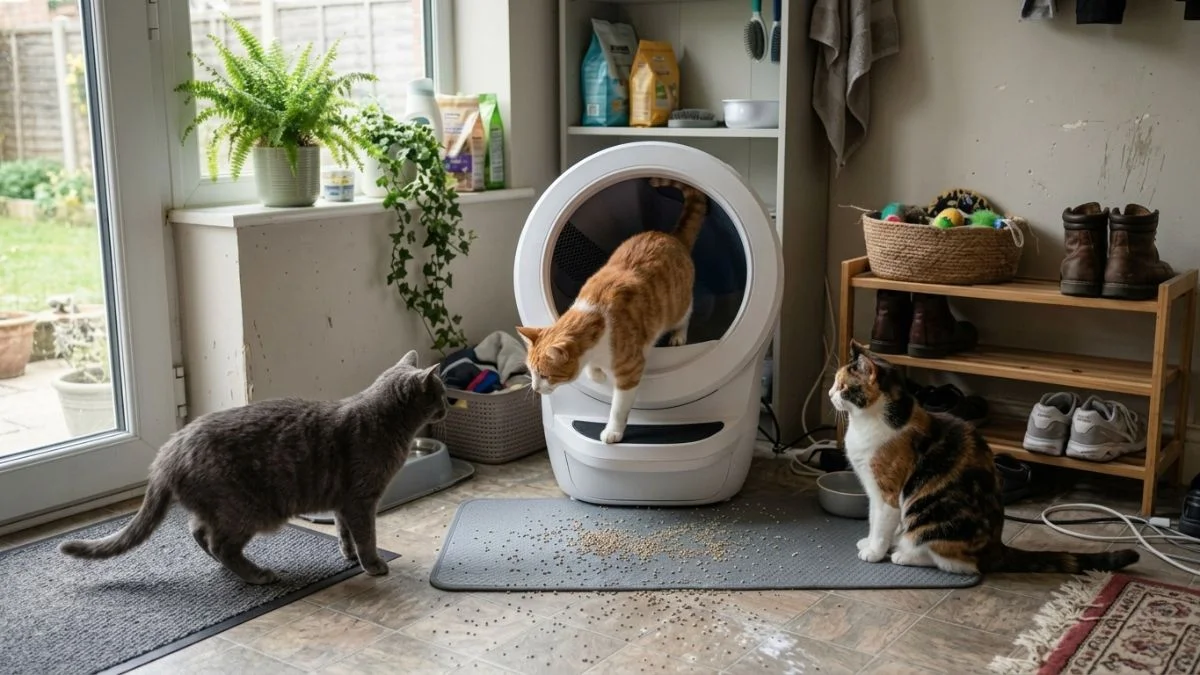
Here’s what a typical multi-cat self-cleaning setup looks like in a real home:

Alternative Models and Their Benefits
Other brands use different cleaning mechanisms.
Some rely on rake systems, which can be effective but may jam if the litter type isn’t compatible.
Newer models like the Litter-Robot 5 introduce advanced features, including individual cat recognition and behavior tracking through video and app data.
These upgrades can provide deeper insights into your cats’ habits, making them especially useful for owners focused on health monitoring.
Ultimately, the right choice depends on whether you prefer simple automation or more advanced tracking features.
Exploring the Litter-Robot 4: Features, Performance, and User Experience
Smart connectivity and quiet operation define the overall user experience of the Litter-Robot 4. This advanced unit features a top-mounted control panel, making it easier to access compared to older front-button designs.
Wi-Fi Connectivity and Quiet Operation
Its Wi-Fi connectivity allows you to monitor your cat’s habits directly from your smartphone. You can track usage patterns in real time, giving you peace of mind even when you’re away from home.
Quiet performance is one of its standout features.
The slow, controlled rotation sifts waste efficiently without startling your cats, helping maintain a calm and stress-free environment.
Users also appreciate the built-in nightlight, which makes it easier for older cats to navigate the unit at night.
Tester Jessica Hartshorn noted that the app interface is intuitive and easy to use.
The sleek design blends well into modern homes, delivering reliable performance and a more convenient daily routine.
Essential Litter Considerations for Optimal Odor Control
The material you use in your self-cleaning litter box is one of the most important factors for performance. It directly affects odor control and how reliably the system operates.
For a consistently fresh environment, you need a litter that performs well. The right option locks in odors immediately and forms solid clumps that are easy to separate.
Choosing the Right Clumping Litter
You should use a premium, fast-clumping formula. Hard, solid clumps form quickly and sift cleanly, helping the system work as intended.
Brands like Tidy Cats, Scoop Away, and Arm & Hammer are popular choices because they are compatible with rotating sifting systems.
Avoid crystal or paper-based litters. These don’t form tight clumps and can interfere with the cleaning mechanism.
Tester Jessica Hartshorn noted that the unit hides waste so effectively that she became less concerned about the specific brand over time.
Choosing the right litter helps maintain efficient cleaning cycles and keeps the waste drawer odor-free for longer.
Always keep the litter level between the indicated lines. This ensures the sensors can accurately detect your cat’s presence.
Here’s a quick comparison of litter types that work best with automatic litter boxes — and which ones to avoid:
| Litter Type | Works with Sifting Units? | Primary Benefit | Key Consideration |
|---|---|---|---|
| Premium Clay Clumping | Yes | Superior odor control and fast clumping | Recommended for best overall performance |
| Silica Crystal | No | High absorbency | Does not clump and may jam the mechanism |
| Paper/Wood Pellet | No | Biodegradable and eco-friendly | Breaks down easily and is not suitable for sifting systems |
| Lightweight Clumping | Check manufacturer guidelines | Easier to handle and carry | May be too light for accurate sensor detection |
Installation and Setup Tips Based on Real-World Experiences
Setting up your self-cleaning litter box correctly from the start helps prevent many common issues. Proper installation ensures reliable performance and keeps your home environment fresh.
Jessica Hartshorn recommends setting aside at least an hour to properly assemble the unit and connect it to the app. This initial effort pays off with smoother, more consistent operation.
Proper Placement and Initial Configuration
Placement is critical.
The unit should be positioned on a flat, level surface to ensure the weight sensors work accurately.
During setup, avoid placing the unit too close to a wall, as limited clearance can interfere with the dome’s rotation.
Following the manufacturer’s instructions carefully helps prevent common issues and ensures the system detects your cat’s presence correctly.
Pairing with Mobile Apps and Setup Hacks
Connecting the app may take a few attempts at first.
Once paired, the system is usually stable and maintains a reliable connection.
Hartshorn also suggests keeping the old litter box available for a few weeks.
This allows your cats to transition gradually to the new system, reducing stress and avoiding rejection.
| Setup Step | Key Benefit | User Tip |
|---|---|---|
| Level surface placement | Accurate sensor readings | Use a spirit level to ensure proper alignment |
| Wall clearance | Smooth, uninterrupted dome rotation | Leave at least 3–5 inches of space around the unit |
| App pairing | Remote monitoring and alerts | Restart your router if the connection fails |
| Transition period | Reduces stress and anxiety for cats | Keep the old litter box until new habits are established |
Maintaining Your Automatic Litter Box for Consistent Performance
To keep your self-cleaning litter box running smoothly over time, a consistent maintenance routine is essential. It ensures reliable performance and helps maintain a clean, fresh home environment.
Your effort directly impacts both the unit’s lifespan and overall hygiene. Regular care helps prevent small issues from turning into bigger problems.
Routine Cleaning Practices
The waste drawer usually needs to be emptied about once a week.
In multi-cat households, this frequency will naturally increase.
- Clean the globe and waste drawer consistently. A quick wipe-down every week or two helps prevent dust and bacteria buildup and keeps the unit sanitary.
- Perform a deep clean every few months. Use a pet-safe, non-abrasive cleaner on all interior surfaces to maintain performance.
- Monitor the waste drawer through the app. Checking levels regularly helps prevent overfilling and keeps the system running smoothly.

Keep the surrounding area clean.
Your cats’ comfort depends on a tidy space just as much as a properly functioning unit.
Adhering to a consistent maintenance routine extends the unit’s lifespan and ensures reliable performance.
Following these steps helps protect your investment and maintain a clean, comfortable environment for your pets.
Practical Tips for Managing Multi-Cat Litter Box Use
Veterinary guidelines offer a clear roadmap for managing hygiene in multi-cat homes. Experts like the ASPCA recommend one litter box per cat, plus one extra. This rule is essential for maintaining harmony.
Your strategy should go beyond the self-cleaning unit itself.
Thoughtful placement and observation are key to making the system work well with multiple cats.
Extra Litter Boxes and Cat Behavior Insights
Even with an automatic litter box, it’s still a good idea to keep a traditional option available.
This gives your cats a choice and helps reduce competition.
Shy or more sensitive cats benefit from a quiet, low-traffic location where they feel safe using the litter box.
Observing your cats during the transition period can provide valuable insights.
You’ll quickly notice which setup they prefer and how they adapt over time.
The connected app adds another layer of monitoring by helping track usage patterns and potential changes in behavior.
| Practical Tip | Key Benefit | How to Implement |
|---|---|---|
| Provide an extra manual litter box | Reduces territorial stress | Follow the “one box per cat, plus one extra” rule |
| Place the unit in a quiet area | Encourages shy or sensitive cats | Choose low-traffic spots away from noise |
| Use the connected app for tracking | Supports early health monitoring | Review usage patterns and frequency weekly |
| Observe behavior during the transition | Helps ensure a smooth adjustment | Watch for preferences and any signs of avoidance |
Automatic Litter Box for Multiple Cats — Is It Worth It? Final Verdict
The final decision comes down to a simple cost–benefit balance.
It depends on your budget and how much you value convenience in your daily routine.
Budget Considerations vs. Long-Term Value
The $700 price tag is significant.
However, the long-term value comes from the time you save and a consistently fresher home environment.
For households with two or three cats, this trade-off often makes sense.
You’re exchanging an upfront investment for ongoing convenience, better hygiene, and less daily effort.
When to Invest and When to Hold Back
If you travel often or have a demanding schedule, the convenience is hard to ignore.
An automatic litter box can provide reliable care while you’re away.
For those on a tighter budget, a traditional setup with a quality scoop can still be effective.
These systems are best suited for households looking to reduce the daily effort of manual cleaning.
| Scenario: Invest Now | Scenario: Consider Waiting |
|---|---|
| You have 2–3 cats and value your time highly | Your budget is currently very tight |
| Your schedule is busy or involves frequent travel | You only have one cat |
| You prefer a hands-off approach to daily cleaning | You don’t mind the daily scooping routine |
| Long-term convenience outweighs the upfront cost | You prefer to allocate your budget to other priorities |
Ultimately, your decision should reflect your household’s needs, budget, and daily routine.
Additional Insights from Expert Reviews and Cat Product Testing
Beyond manufacturer claims, the true value of these devices comes from long-term user experience and professional testing. This feedback provides a more realistic view of daily performance.
Lynn Redmile, a Good Housekeeping contributing product analyst, has used a Litter-Robot for years. She highlights its solid engineering and consistent performance under heavy use.
Feedback from Real-World Use and Consumer Reviews
Expert reviews from organizations like Good Housekeeping emphasize the reliability of the Litter-Robot 4. Months of real-world testing confirm its durability over time.
Consumer feedback often points to the ease of use of the connected app. It allows owners to monitor waste levels and litter usage without constant manual checking.
Many users also report a faster-than-expected transition period for their cats, especially when the recommended setup steps are followed.
Overall, the consensus is that features like quiet operation and strong odor control justify the premium price.
Feedback from a large number of users shows that most multi-cat households see a positive improvement in their routine.
| Insight Source | Key Finding | Practical Implication |
|---|---|---|
| Expert reviews | Rigorous testing confirms long-term reliability | You can rely on consistent performance for daily use |
| Consumer feedback | App notifications simplify waste management | Remote monitoring reduces the need for manual checks |
| User reports | Transition is often smooth with proper setup | Following guidelines helps cats adapt more easily |
| Tester consensus | Advanced features justify the higher cost | The investment delivers convenience and better hygiene |
Conclusion
Our review leads to a clear verdict on modern pet hygiene solutions.
Investing in a self-cleaning litter box is a significant decision that can transform your daily routine. Our testing shows that the Litter-Robot 4 stands out for its reliable performance and strong odor control.
While the upfront cost is high, the long-term benefits are substantial. You gain more efficient waste management and spend far less time on daily cleaning. Features like app-based monitoring also provide useful insights into your cats’ habits.
It’s important to consider your space, budget, and your cats’ individual preferences. The goal is to create a clean, low-stress environment for your home.
This guide is designed to help you decide if this type of system fits your needs. Choosing the right litter and maintaining the unit properly will ensure consistent performance over time.
Automatic Litter Box FAQ
Do these self-cleaning units truly save time in a busy home?
Yes, they significantly reduce daily scooping. In multi-cat households, the system handles waste after each use. You’ll mainly manage the waste drawer, emptying it every few days instead of constant manual cleaning.
How well do they control odor with multiple cats?
Modern units with sealed waste compartments and carbon filters perform very well. Waste is isolated quickly, keeping the main area fresher than a traditional box. Regular emptying is key for best results.
Can multiple cats safely use one automatic unit?
Most can, but it depends on your cats’ behavior and the unit’s capacity. It’s important to provide an extra litter box during the transition and watch for signs of stress or avoidance.
What are the most common issues with heavy daily use?
Sensors may get dirty and affect cleaning cycles. The waste drawer fills faster, and some litter types can cause residue buildup. Regular maintenance and proper litter choice prevent most issues.
Is the Litter-Robot 4 a good option for three cats?
Yes, it’s one of the top choices for multi-cat homes. Its large capacity, quiet operation, and app tracking features make it well-suited for frequent daily use.
What type of litter works best in these systems?
Use premium, fast-clumping, low-dust clay litter. Avoid crystal, non-clumping, or lightweight options, as they can interfere with the mechanism.
Are there ongoing costs beyond the initial purchase?
Yes. You’ll need liners or waste bags, occasional filters, and regular litter refills. These costs are relatively small compared to the time and convenience gained.