

Do Cats Actually Like Automatic Litter Boxes? The Truth Most Owners Learn Too Late
You bought an automatic litter box to make life easier…
but now your cat won’t use it.
No illness. No past issues. Just sudden refusal.
Frustrating, right?
Here’s what most owners don’t realize:
It’s usually not the cat — it’s the way the transition was done.
Cats don’t reject technology.
They reject noise, unpredictability, and discomfort.
And one small mistake — often made in the first 24 hours —
can be enough to make a cat avoid the box completely.
That’s why so many owners feel confused.
The product promises convenience, but the experience doesn’t match expectations.
So what’s actually going on?
Behavior experts consistently point to the same issue:
cats are highly sensitive to changes in their environment — especially in places tied to safety and routine.
According to Companion Animal Behavior specialist Yody Blass, these systems can work well for busy households — but they are not a plug-and-play solution for every cat.
Even data from manufacturers like Whisker suggests high success rates — often over 95% — but that success depends heavily on a proper introduction.
In other words:
The question isn’t whether cats like automatic litter boxes.
It’s whether they feel safe using them.
Key Takeaways
- Most cats can adapt to automatic litter boxes with the right introduction
- The biggest mistake is rushing the process, especially turning the unit on too early
- Noise and movement are the main triggers of rejection
- A bad first experience can create long-term avoidance
- Most cats adjust within a few days to a week when introduced correctly
- Monitoring waste is still essential — these are not fully hands-free
- Comfort and stability matter more than convenience when choosing a setup

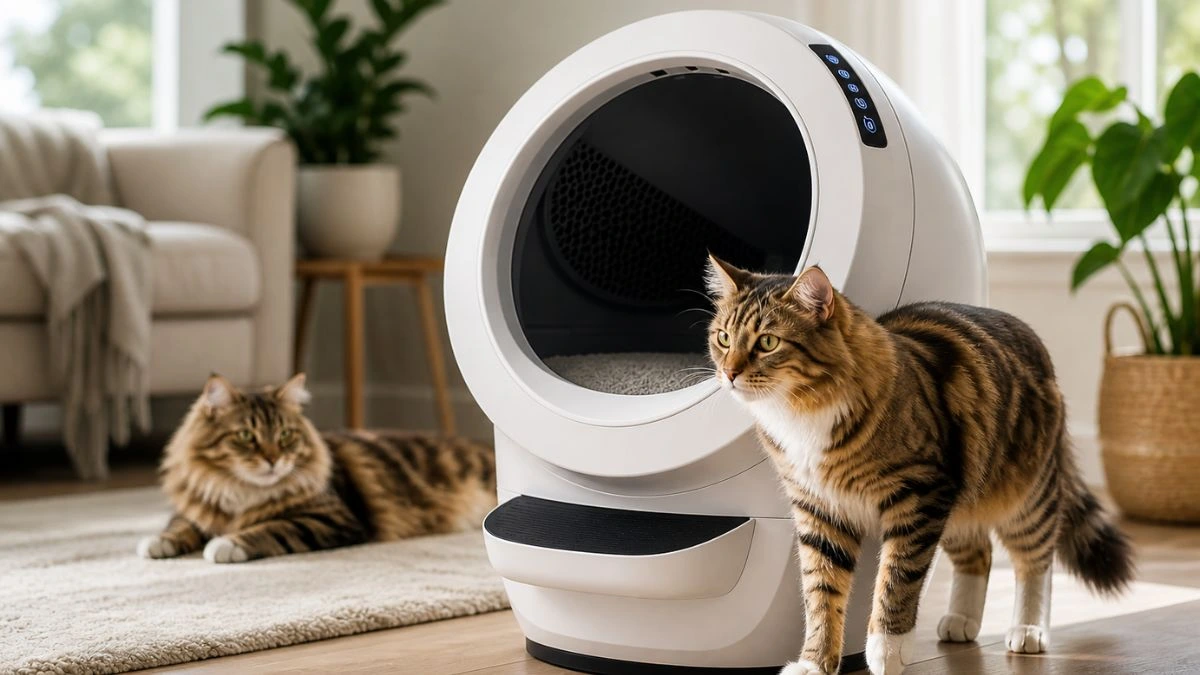
Two cats near Litter-Robot 4 automatic litter box in a modern home environment
Understanding Automatic Litter Boxes: The Basics
Before choosing any model, it’s important to understand one thing:
these devices don’t fail because of technology — they fail because of how they’re used.
Automatic litter boxes are designed to keep the environment consistently clean.
But for your cat, that consistency only matters if the experience feels safe and predictable.
If you’re not fully familiar with how these systems behave during daily use,
it becomes much easier to make mistakes that lead to rejection.
This is why understanding how automatic litter boxes actually work in real life is critical before expecting your cat to accept one.
How Self-Cleaning Litter Boxes Work
Most automatic units use sensors or timers to detect when your cat leaves the box.
After a short delay, a cleaning cycle begins and separates waste from clean litter.
Some models use a raking system, slowly pushing waste into a sealed compartment.
Others use a rotating globe, which sifts and isolates clumps automatically.
More advanced systems can even connect to water lines to flush waste away —
but regardless of the design, the goal is always the same:
keep the litter box clean after every use.
If you want a deeper breakdown of different systems and mechanisms,
understanding how automatic litter boxes work step by step can help you choose the right type for your setup.
Pros and Cons at a Glance
The biggest advantage is simple:
your cat always steps into a clean litter box.
This can improve hygiene, reduce odor, and make life easier — especially for busy households.
However, there’s a common misconception:
these devices are not completely hands-free.
You still need to:
- empty the waste drawer
- check litter levels
- monitor your cat’s usage
And that last point is critical.
Manual scooping used to give you daily insight into your cat’s health — and that responsibility doesn’t disappear.
If your unit starts behaving inconsistently, it’s often not a defect —
learning how to identify why an automatic litter box is not cleaning properly can help you fix the issue quickly before it affects your cat’s habits.
Real Cat Behavior: Do Cats Like Automatic Litter Boxes?

Feline behavior experts consistently point to one key truth:
cats don’t judge the technology — they react to the experience.
Acceptance isn’t automatic.
It depends on personality, past experiences, and how the litter box behaves during use.
While many cats adapt successfully, that success is not random — it’s created by the setup.
Even manufacturers report high adaptation rates, often above 90%.
But those numbers only hold true when the introduction is done correctly.
This is why many owners get confused —
the product works, but the cat still refuses it.
In most cases, the issue isn’t the litter box.
It’s how the cat was introduced to it.
Myths vs. Reality
A common myth is that cats will naturally accept automatic litter boxes.
Reality is more nuanced.
Some cats love the consistently clean environment.
Others feel threatened by noise, movement, or unfamiliar structure.
And forcing the transition often makes things worse — not better.
If your cat already seems hesitant, it’s important to understand
whether automatic litter boxes are actually a good fit for your cat’s behavior before pushing the transition further.
| Common Myth | Behavioral Reality | Practical Impact |
|---|---|---|
| Every cat will immediately use a self-cleaning litter box | Personality dictates acceptance; some cats prefer familiar setups | Rushing the process often leads to rejection |
| The cleaning cycle is harmless and ignored | Movement and sound can create fear or hesitation | You must monitor your cat’s reaction closely |
| Automatic boxes work for all cats | Size, age, and temperament matter | Always check compatibility before choosing |
Signs of Rejection and Acceptance
Your cat will tell you very clearly whether something is wrong —
you just need to know what to look for.
Signs of rejection:
- Avoiding the litter box completely
- Eliminating outside the box
- Entering but not using it
- Showing signs of stress or hesitation
These are not random behaviors — they are signals.
Ignoring them can lead to long-term avoidance.
Common Mistakes That Affect Cat Acceptance

Many cat owners don’t realize it, but acceptance often fails because of small mistakes made in the first few days.
These aren’t complex issues.
They’re simple decisions that create stress, confusion, and long-term avoidance.
The good news?
They’re all fixable — if you catch them early.
Turning It On Too Early
This is the most common mistake.
You set up the automatic litter box, your cat uses it once…
and then the cleaning cycle activates.
Sudden noise + movement = instant distrust.
From your cat’s perspective,
the “safe bathroom” just became unpredictable.
That single moment can be enough to create long-term hesitation.
The fix is simple:
- Keep the unit turned off at the beginning
- Let your cat use it naturally
- Only activate it after consistent, confident use
Rushing this step is one of the fastest ways to create rejection.
Poor Placement and Environmental Factors
Location plays a bigger role than most people think.
Placing the litter box in a busy, noisy area — near laundry machines, hallways, or constant movement —
creates stress every time your cat tries to use it.
And here’s where things get worse:
a bad location combined with a new, unfamiliar device amplifies anxiety.
In many homes, this mistake alone is enough to cause avoidance —
understanding where to place an automatic litter box correctly can make a huge difference in acceptance.
Removing the Old Box Too Soon
This mistake forces your cat into a decision they’re not ready to make.
The old litter box represents:
- familiarity
- safety
- routine
Removing it too early creates pressure —
and pressure leads to rejection.
Cats don’t adapt well when forced.
They adapt when they feel in control.
The correct approach:
- Keep both boxes available
- Allow natural preference to develop
- Remove the old one only after consistent use of the new system
| Common Mistake | Impact on Your Cat | Recommended Fix |
| Turning the unit on too early | Creates fear of sound and movement | Keep unplugged for the first few days |
| Placing it in a busy or noisy area | Causes stress and avoidance | Choose a quiet, low-traffic location |
| Removing the old box too soon | Eliminates a safe fallback option | Keep both boxes during transition |
Impact of Noise and Movement on Your Cat
Noise and movement are two of the most important factors that determine whether your cat will accept an automatic litter box.
What feels normal to you
can feel unpredictable — even threatening — to your cat.
Their senses are far more sensitive, especially when it comes to sound and sudden motion.
And when that happens in a place tied to safety,
like a litter box, the reaction becomes much stronger.
How Noise Influences Feline Behavior
Your cat’s hearing is extremely sharp.
Even a low mechanical hum — something you barely notice —
can be enough to create discomfort or hesitation.
For more sensitive cats, that sound can quickly turn a private, safe space
into a place associated with stress.
Manufacturers try to reduce this issue with quieter systems and improved engineering.
Some newer models focus heavily on noise reduction and smoother operation,
which can make a noticeable difference in how quickly a cat adapts.
If you’re comparing quieter models and trying to understand which ones perform better in real homes,
it helps to look at which automatic litter boxes are actually designed to stay odor-free and low-noise.
Movement Sensitivity and Triggered Fears
Sudden movement is often an even bigger trigger than sound.
Even if the system pauses when sensors detect your cat,
the initial motion or rotation can still cause fear.
And here’s the critical part:
If your cat gets startled inside the box, that memory sticks.
After that, avoidance becomes very likely.
This is how many long-term rejection issues begin.
If a cat feels trapped or surprised,
it breaks the sense of control — and control is everything for cats.
For more sensitive or cautious cats,
increasing the delay before the cleaning cycle starts can help reduce stress significantly.
This gives your cat enough time to:
- leave the area completely
- feel safe again
- avoid associating the box with sudden movement
When you manage both noise and movement correctly,
you dramatically increase the chances of acceptance.
Because in the end,
your cat isn’t reacting to the technology —
they’re reacting to how it feels.
Transitioning Your Cat to an Automatic Litter Box
A successful transition doesn’t happen by chance.
It happens when your cat feels safe, in control, and not forced into change.
This is where most owners go wrong —
they rush the process and expect instant adaptation.
But cats don’t work like that.
They need time to observe, explore, and build trust.
Behavior specialists consistently recommend a gradual approach,
keeping the familiar litter box available during the transition.
This gives your cat a sense of security —
and that security is what allows adaptation to happen.
Simple Transition Method and Timelines
Start by placing the new automatic litter box next to the old one.
Keep it turned off.
Let your cat explore it naturally, without pressure or noise.
To increase acceptance:
- Add a small amount of used cat litter into the new box
- Maintain the same litter type your cat is already used to
- Avoid any sudden changes in environment
Familiar scent = faster trust.
Only after your cat is using the new box consistently
should you activate the cleaning cycle.
Turning it on too early is one of the fastest ways to create rejection.
| Phase | Key Action | Timeline |
|---|---|---|
| Exploration | Place new unit next to old, keep it unplugged | 2–3 days |
| Initial Use | Cat starts using new box, keep power off | 3–5 days |
| Activation | Turn on cleaning cycle after consistent use | 1–2 days |
| Full Transition | Remove old box once preference is clear | 1–2 weeks |
Quick Fixes for Common Issues
If your cat hesitates or avoids the box, don’t panic.
Most problems are caused by small setup mistakes — and can be fixed quickly.
Start by checking:
- Litter level (too much or too little can affect comfort)
- Sensor cleanliness (dirty sensors affect detection)
- Noise timing (cycle activating too soon)
During the first few days,
you can manually scoop the automatic litter box to avoid triggering the cleaning cycle.
This helps your cat associate the new location with safety first —
before introducing movement and sound.
If your cat continues to show hesitation or inconsistent use,
it’s often not just behavior — learning how to maintain an automatic litter box properly can prevent many of these issues from happening in the first place.
Patience is the key factor here.
Because once your cat feels safe,
adaptation becomes natural — not forced.
Real-World Examples: What Actually Makes a Difference
At this point, it’s not just about whether automatic litter boxes work —
it’s about which features actually influence your cat’s acceptance.
Because in real-world use, small differences matter.
Some models focus on reducing noise.
Others prioritize space, stability, or smoother cleaning cycles.
And those details can directly impact how your cat reacts.
Key Features That Improve Cat Comfort
One of the biggest factors is how the unit behaves during and after use.
For example, some newer models focus heavily on:
- quieter operation
- smoother movement
- more accurate sensors
All of these reduce the chances of startling your cat.
If you want to see how these features perform in practice,
it helps to look at how systems like the Litter-Robot 4 actually behave in real home use.
Larger cats, on the other hand, often struggle with smaller units.
That’s where space becomes critical.
Some designs offer:
- wider entry points
- more interior room
- better turning space
And that can be the difference between comfort and rejection.
Advantages and Real Limitations
The biggest benefit of automatic litter boxes is consistency.
A clean litter box after every use reduces odor, improves hygiene,
and makes the experience more comfortable for your cat.
But there’s a misconception that needs to be clear:
these systems are not maintenance-free.
You still need to:
- empty the waste drawer
- monitor usage
- check litter condition
And that last part is essential.
Because your cat’s health signals still depend on your observation — not the machine.
At the end of the day,
the “best” model isn’t the most advanced one.
It’s the one your cat feels comfortable using consistently.
Conclusion
At the end of the day, automatic litter boxes don’t fail because cats “don’t like them.”
They fail when the experience feels unsafe, unpredictable, or forced.
Your cat isn’t rejecting the technology.
They’re reacting to how it feels.
That’s why the difference between success and rejection
almost always comes down to setup, timing, and environment.
If you take the time to introduce the system properly,
respect your cat’s pace,
and create a calm, predictable experience…
most cats will adapt — and many will prefer it.
But here’s what matters most:
no automatic system replaces your observation.
Monitoring your cat’s behavior, routine, and health signals
will always be part of responsible pet care.
Because in the end, the best automatic litter box
isn’t the most advanced one.
It’s the one your cat actually feels comfortable using.
Do Cats Like Automatic Litter Boxes? FAQs
Do cats actually like automatic litter boxes?
Yes — most cats can adapt and even prefer them.
But acceptance depends on how the box is introduced. A rushed setup or early activation often leads to rejection.
Why is my cat refusing the automatic litter box?
The most common reasons are noise, sudden movement, or poor placement. If your cat feels unsafe, it will avoid the box — even if it used it once before.
How long does it take for a cat to get used to an automatic litter box?
Most cats adjust within 3 to 7 days, but some may take up to 2 weeks. A slow, gradual introduction significantly improves success.
What is the biggest mistake when switching to an automatic litter box?
Turning it on too early. The cleaning cycle can scare your cat and create long-term avoidance.
Are automatic litter boxes safe for all cats?
They are safe for most adult cats. However, very young kittens or highly anxious cats may need extra caution or a slower transition.
Should I remove the old litter box right away?
No.
Always keep the old litter box during the transition. Removing it too soon can cause stress and accidents.
What should I do if my cat still won’t use it?
Turn the unit off, place it next to the old box, and restart the transition slowly.If rejection continues, the issue is usually setup — not the cat.