Litter-Robot 4 Review (2026): Is It Worth It or Overhyped?
Affiliate Disclosure: As an Amazon Associate, we earn from qualifying purchases. This post may contain affiliate links at no extra cost to you. We only recommend products we trust.
Expert Verdict (Quick Summary)
If you want to completely eliminate daily scooping and keep your home consistently odor-free, the Litter-Robot 4 is one of the best automatic litter boxes you can buy in 2026.
It’s ideal for busy cat owners, multi-cat households, and anyone tired of dealing with litter box smell and constant cleaning.
However, the high upfront price means it’s not for everyone — and there are a few limitations you should know before buying.
If you’re still comparing options, check our full guide to the best automatic litter boxes:
https://cattechadvisor.com/best-automatic-litter-box-for-cats-2026-3-self-cleaning-litter-boxes-compared/
Did you know the average cat owner spends over 70 hours per year scooping litter?
That’s time lost every single day on one of the most unpleasant parts of owning a cat.
And if you’ve ever dealt with lingering odors, constant cleaning, or a messy litter area, you already know how frustrating it can be.
That’s exactly why automatic litter boxes have exploded in popularity.
Models like the Litter-Robot 4 promise something simple but powerful:
A self-cleaning litter box that removes waste automatically
A cleaner home with less odor
And no more daily scooping
But here’s the real question:
Is the Litter-Robot 4 actually worth the price, or is it just an expensive gadget?
In this in-depth review, you’ll discover how it works, its real pros and cons, and whether it’s the right choice for your home.
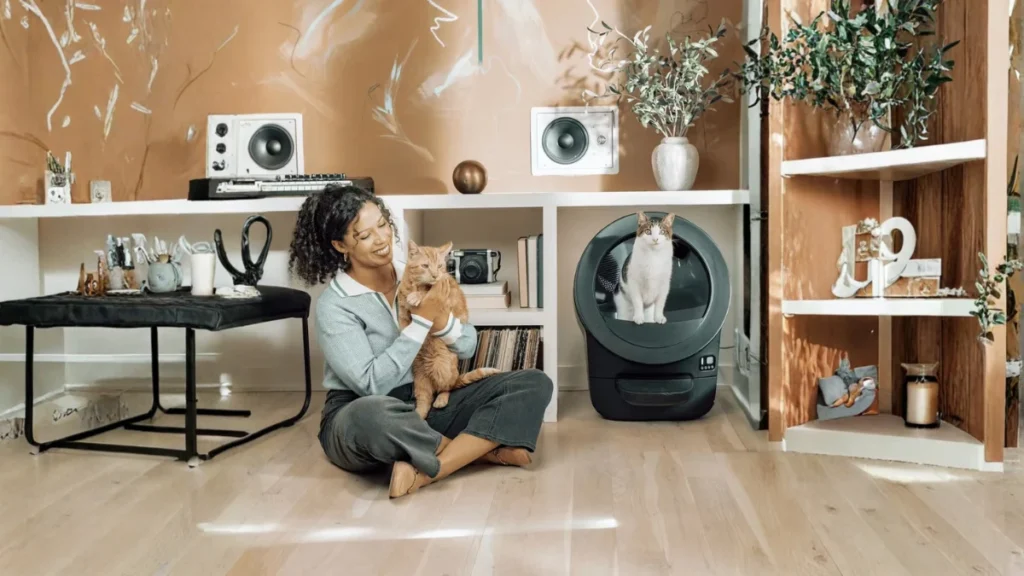
This isn’t just a small upgrade in pet care — it’s a complete shift in how you manage your cat’s litter box.
Instead of dealing with daily scooping, odor buildup, and constant cleaning, a premium self-cleaning system like the Litter-Robot 4 handles everything automatically.
In real-world use, this means less smell in your home, less mess around the litter area, and significantly less time spent on maintenance.
For many cat owners, that alone is a game-changer.
But convenience is only part of the story.
Modern automatic litter boxes combine smart sensors, quiet cleaning cycles, and app connectivity to give you full control over your cat’s routine. You’re not just cleaning less — you’re also gaining better insight into your cat’s habits and overall health.
If you’re still unsure whether this technology actually delivers on its promise, it’s worth understanding how these systems work in practice:
https://cattechadvisor.com/how-do-automatic-litter-boxes-work-complete-guide-to-self-cleaning-systems-2026/
Over one million users have already made the switch, but that doesn’t automatically mean it’s the right choice for every home.
So before you invest in a premium model, it’s important to look beyond the marketing.
In this review, we’ll break down exactly how the Litter-Robot 4 performs in real-life use, where it excels, where it falls short, and whether it’s truly worth the price.
Introduction: The End of the Scoop Era
For most cat owners, the routine is always the same: scoop, bag, deal with the smell… and repeat the next day.
It’s one of those daily tasks that never really goes away — and over time, it becomes one of the most frustrating parts of owning a cat.
The problem isn’t just the effort.
It’s the constant odor, the mess around the litter box, and the feeling that no matter how often you clean, it’s never completely fresh.
This is exactly the pain point that led to the rise of automatic litter boxes.
Instead of relying on manual cleaning, these systems detect when your cat finishes and remove waste automatically — keeping the litter consistently clean with minimal effort from you.
If you’ve ever wondered whether this technology actually delivers on that promise, you’re not alone.
https://cattechadvisor.com/do-automatic-litter-boxes-really-work-honest-pros-cons-real-results-2026/
The idea sounds simple, but the real difference comes down to how well the system works in everyday use — and whether it truly solves the problems that traditional litter boxes never could.
This shift marks the real end of manual scooping, and the impact goes beyond convenience.
In practice, what most owners notice first is the psychological relief. You’re no longer thinking about cleaning the litter box every day, and that constant mental “to-do” simply disappears. You gain back time, reduce stress, and remove one of the most unpleasant daily chores from your routine.
That’s why this type of system has become especially valuable for busy professionals and frequent travelers. In real-world use, many owners highlight the same benefit:
“What motivated me was travel… I wanted our two cats to have a clean bathroom, whether we were home or not.”
This captures something important. It’s not just about automation, it’s about consistency. A consistently clean litter box, without relying on your schedule, is what truly changes the experience of owning a cat — and that’s exactly what systems like the Litter-Robot 4 are designed to deliver
Hygiene improves dramatically with automatic systems. Because waste is removed shortly after each use, there’s less time for bacteria to build up and odors to spread throughout your home. The result is a cleaner litter area and a noticeable reduction in that persistent “litter box smell.”
Over time, there are also practical benefits. These systems tend to use litter more efficiently, since only clumped waste is removed. In real-world use, many owners notice they go through less litter and rely less on disposable bags and liners.
That said, it’s normal to feel skeptical at first. Questions about price, reliability, and whether your cat will actually use it are common. Most owners go through this same hesitation before switching.
The difference is that newer models have significantly improved in both safety and performance. If you’re concerned about how secure these systems really are, it’s worth understanding how modern safety features work in practice:
https://cattechadvisor.com/are-automatic-litter-boxes-safe-for-cats/
Among the options available today, one model consistently stands out for its design, reliability, and overall performance: the Litter-Robot 4.
In the next section, we’ll break down exactly how it works and what makes it different from other automatic litter boxes.
How the Litter-Robot 4 Works: A Glimpse into Automated Cleaning
How does a machine actually take over the job of scooping litter?
At first, it might sound complex — but in practice, the process is surprisingly simple and efficient.
The Litter-Robot 4 is designed to automate the entire cleaning cycle from the moment your cat steps inside.
It starts with a set of advanced sensors that detect when your cat enters and exits the unit. Once your cat leaves, the system activates a timer, allowing the litter enough time to form solid clumps.
This timing is crucial.
In real-world use, proper clumping is what ensures the system can separate clean litter from waste effectively — which is why the delay feature plays such an important role in overall performance.

A fully automatic self-cleaning litter box designed to eliminate daily scooping and keep your home consistently odor-free.
• Fully automated cleaning cycle → no daily maintenance
• Advanced sensors → detects when your cat enters and exits
• Wi-Fi app control → monitor usage and receive alerts
• Sealed waste drawer → better odor control
Ideal for busy cat owners and multi-cat households who want a cleaner, low-maintenance setup.
The Patented Sifting Cycle: Quiet and Efficient
The cleaning cycle is where the Litter-Robot 4 truly stands out.
Instead of using a rake or complex mechanical parts, the entire globe rotates slowly in a smooth, controlled motion. This patented sifting system is designed to separate waste from clean litter with minimal noise and maximum efficiency.
As the globe turns, clean litter passes through an internal sieve, while clumps are gently separated and deposited into a sealed waste drawer below. What’s left behind is a consistently clean bed of litter after every use.
In real-world use, this makes a noticeable difference.
You’re not dealing with partially clean litter or leftover residue — the system maintains a level of cleanliness that’s difficult to achieve with manual scooping.
Another major advantage is how quiet the process is. Many users describe the sound as similar to a soft rainstick, which makes it suitable even for nighttime use or for cats that are sensitive to noise.
You can also adjust the delay before each cleaning cycle starts. This allows enough time for clumping litter to solidify properly, improving separation and reducing waste.
Over time, this efficiency adds up.
Because the system only removes clumped waste and preserves clean litter, many owners notice they use significantly less litter compared to a traditional box — which helps offset the initial investment.
Smart Sensor Technology: Lasers and Weight Detection
One of the biggest concerns with automatic litter boxes is safety — and this is where the Litter-Robot 4 really stands out.
Instead of relying on basic motion detection, it uses an advanced combination of laser sensors and weight detection to monitor your cat’s activity in real time.
The system continuously maps the interior of the globe, accurately detecting when your cat enters, exits, or is still inside. This ensures the cleaning cycle only starts when it’s completely safe.
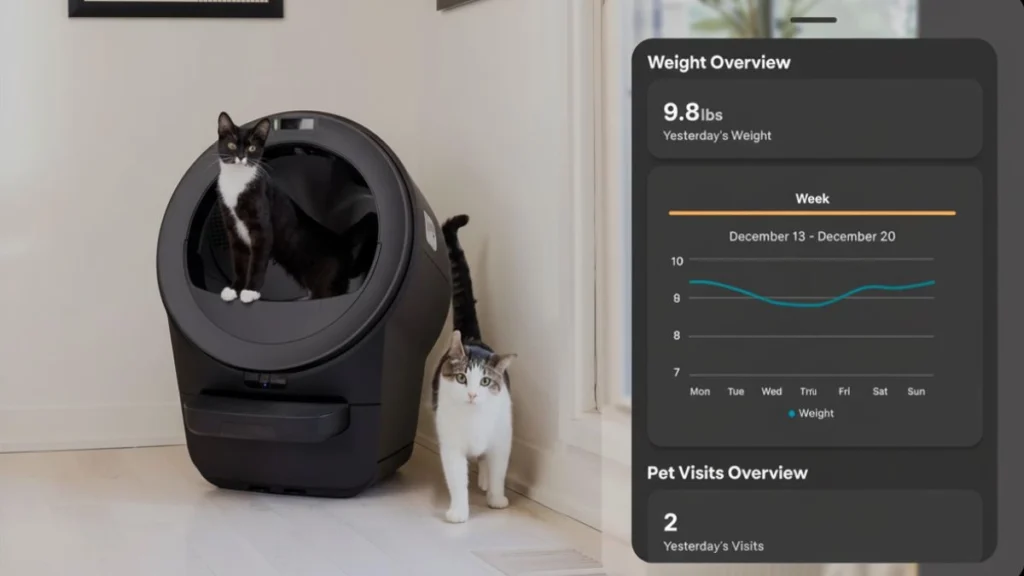
At the same time, built-in weight sensors track each visit. This data is sent to the Whisker app, allowing you to monitor your cat’s weight over time.
In real-world use, this becomes more than just a convenience feature.
Tracking weight trends can help you notice early signs of health issues, such as sudden weight loss or gain — something many owners wouldn’t catch otherwise.
Safety is also built into every step of the process. If a sensor detects movement or interruption, the cycle stops immediately. This eliminates the risk of the unit operating while your cat is inside.
Users consistently report that the detection system is accurate and reliable, triggering the cleaning cycle only after the cat has fully exited.
Compared to other automatic litter boxes that rely on rakes or conveyor systems, this approach is not only quieter but also significantly less prone to mechanical issues.
The result is a system that combines safety, precision, and reliability — turning what used to be a simple litter box into a smart, low-maintenance part of your home.
Design and Build: Form Meets Function in a Modern Dome
One of the first things you notice about the Litter-Robot 4 is how different it looks from a traditional litter box.
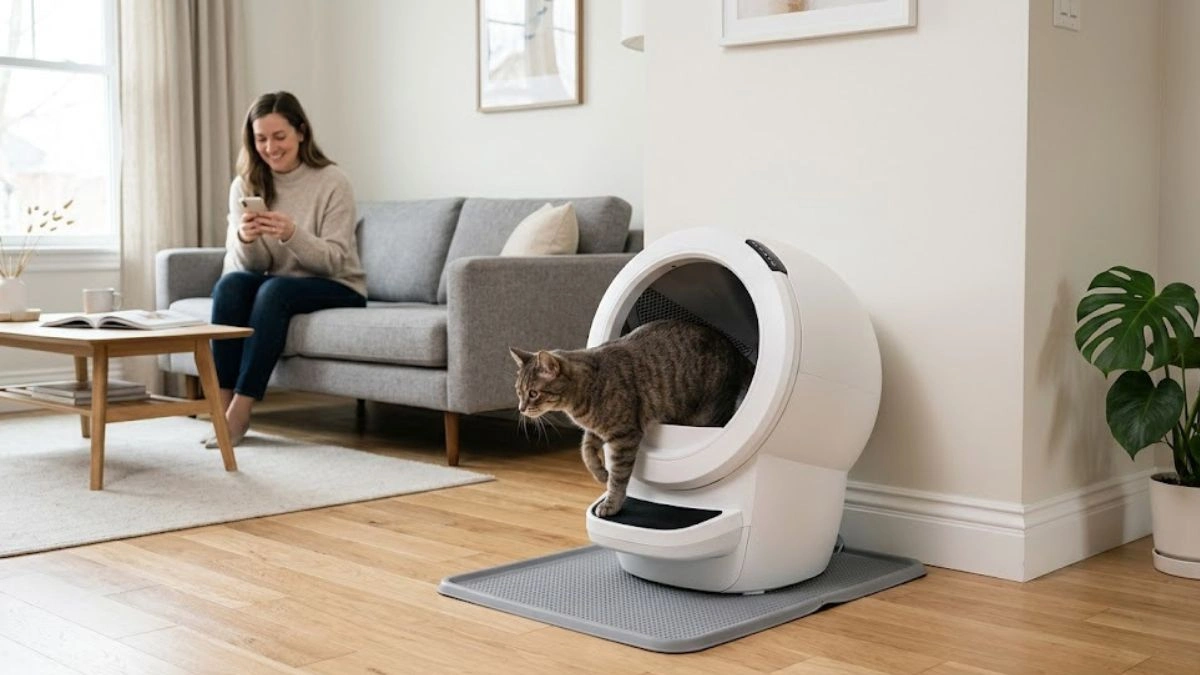
Instead of the typical open plastic tray, it features a sleek, enclosed dome design that feels more like a modern appliance than a pet accessory.
In real-world use, this makes a bigger difference than you might expect.
The rounded globe isn’t just for aesthetics — it also helps contain litter scatter and keeps the cleaning mechanism fully enclosed. This results in a cleaner surrounding area and a more controlled environment overall.
The build quality is another standout point. The materials feel solid and well-constructed, designed to handle daily use without feeling flimsy or cheap. Surfaces are smooth and easy to wipe down, which simplifies regular maintenance.
Many users mention that it blends surprisingly well into their home. Instead of trying to hide it, some owners are comfortable placing it in visible areas like living rooms or open spaces.
That said, the size can be a concern at first.
It’s larger than a standard litter box, and you’ll need to plan where it will go. But for most owners, the trade-off becomes worth it once they experience the reduction in odor, mess, and daily maintenance.
Footprint and Size Considerations for Your Home
Before buying, it’s important to understand that the Litter-Robot 4 is larger than a traditional litter box.
It stands close to 30 inches tall, with a base footprint of approximately 22 by 27 inches. At first glance, this can feel like a lot of space — especially if you’re used to compact, open trays.
In practice, however, the extra size serves a purpose.
The enclosed design helps contain odors, reduce litter scatter, and house the full automated cleaning system. This is what allows it to operate without daily maintenance.
You’ll need a stable, level surface and access to a nearby power outlet. For most homes, placing it in a low-traffic area — such as a laundry room, bathroom corner, or quiet section of a bedroom — works best.
If you live in a smaller space, planning ahead is key.
Once positioned correctly, most owners find that the benefits outweigh the footprint, especially when you factor in less mess, better odor control, and a cleaner overall environment.
Compared to other automatic litter boxes, the space usage is actually quite efficient.
Instead of spreading out across the floor, the vertical design makes better use of height. In practice, this means it takes up less usable space than you might expect once it’s in place.
Another major advantage is the sealed system.
Because waste is fully contained between cleanings, odors are significantly reduced compared to traditional open litter boxes. This makes it much more practical to place the unit in living areas, bedrooms, or other shared spaces without worrying about lingering smells.
Ergonomic Controls and Improved User Interface
Operating the Litter-Robot 4 is surprisingly simple, even if you’ve never used an automatic litter box before.
The control panel is positioned on top of the unit, so you don’t need to bend down to adjust settings — a small detail that makes a noticeable difference in everyday use.
It features five tactile buttons and a clear LED display, giving you quick access to essential functions without needing to rely on the app.
In practice, the interface feels intuitive and easy to navigate, even during the initial setup. Adjusting cycle timing, activating manual cleaning, or turning on the nightlight can all be done in seconds.
The built-in nightlight is another thoughtful addition. It softly illuminates the entry area, helping your cat feel more comfortable using the box at night without disturbing your home environment.
Here are the main controls available directly on the unit:
- Start or pause the cleaning cycle instantly when needed
- Adjust the delay timer to ensure proper litter clumping
- Turn the nightlight on or off for better nighttime visibility
- Check Wi-Fi connection status for seamless app integration
- Monitor drawer full alerts and system status indicators
The interface is designed to keep things simple.
You can control all the essential functions directly from the unit, without relying on a smartphone. In real-world use, this adds an extra layer of reliability that many owners appreciate.
The overall construction also reflects long-term durability. The materials feel solid, resist everyday wear, and are easy to clean — all of which contribute to a product built for consistent daily use.
In the end, the design strikes a strong balance between form and function.
It doesn’t just look modern — it delivers a practical, low-maintenance solution that genuinely improves day-to-day life for both you and your cat.
Setting Up Your Litter-Robot 4: A Step-by-Step Guide
Getting started with the Litter-Robot 4 is easier than it might seem — but taking a few minutes to set it up correctly makes all the difference.
A proper setup ensures the system runs smoothly from day one, helping you avoid common issues like inaccurate sensor readings or connectivity problems.
Most users complete the process in under an hour, even on their first try. The key is simply to follow the steps carefully instead of rushing through the installation.
In real-world use, the only part that may require a bit of patience is connecting the unit to the app. Once that’s done, however, the system becomes much easier to manage and monitor.
Taking the time to set everything up properly upfront will save you time, prevent frustration, and ensure the best possible performance over the long run.
Unboxing, Assembly, and Initial Placement
Unboxing the Litter-Robot 4 is straightforward, and everything you need comes neatly organized inside the package.
You’ll find the main components, including the base, the globe, the waste drawer, the fence attachment, and the power cord.
Assembly is simple and doesn’t require any tools.
Start by placing the base on a flat, stable surface. Then align the globe with the base and rotate it until it locks securely into position.
Next, slide the waste drawer into the front compartment, making sure it fits properly. If your cat tends to kick litter around, attaching the fence to the entryway can help reduce scatter.
Choosing the right location is just as important as the setup itself.
Make sure the unit is placed on a level surface, with enough room for its full footprint and access to a nearby power outlet. You’ll also want to leave enough space around it for the globe to rotate freely during cleaning cycles.
It’s best to avoid areas with high humidity, such as bathrooms with showers, since excess moisture can interfere with sensor performance.
Before adding any litter, take a moment to scan the QR code on the unit and complete the app connection. This small step makes the setup process smoother and prevents potential issues later on.
Connecting to the Whisker App and Wi-Fi
To unlock all smart features, you’ll need to connect the Litter-Robot 4 to the Whisker app.
Start by downloading the app from your device’s app store and creating a free account. The app acts as your control center, allowing you to monitor and manage the unit remotely.
Once the unit is powered on, the control panel will light up. From there, simply follow the step-by-step instructions in the app to complete the pairing process.
You’ll need a stable 2.4 GHz Wi-Fi connection, which is standard in most homes. If your network uses advanced settings or a shared system, you may need to allow the device manually — something that’s common with smart home products.
In real-world use, pairing usually works smoothly, but it may take more than one attempt in some cases. If that happens, restarting the unit and reopening the app typically resolves the issue quickly.
Once connected, the experience becomes much more convenient.
You can monitor waste drawer levels, receive notifications when it’s full, track your cat’s usage, and even receive firmware updates automatically.
Over time, one of the most valuable features is the ability to track your cat’s weight trends. This can help you spot potential health changes early — something that’s easy to miss without consistent data.
| Setup Phase | Estimated Time | Key Action | Tip for Success |
|---|---|---|---|
| Unboxing & Inspection | 10 minutes | Check all components | Lay everything out on a clean floor. |
| Physical Assembly | 15 minutes | Attach globe and insert drawer | Listen for the click to confirm it’s secure. |
| Choosing Location | 5 minutes | Find a level surface near an outlet | Avoid humidity, direct sunlight, and drafts |
| App & Wi-Fi Setup | 20-30 minutes | Download app and pair device | Make sure you’re on a 2.4 GHz network |
| Final Configuration | 5 minutes | Add litter and run a test cycle | Use high-quality clumping clay litter |
After setup, the system handles daily cleaning automatically.
For a single cat household, you’ll typically only need to empty the sealed waste drawer about once per week. The rest of the process runs on its own, keeping the litter consistently clean with minimal effort.
This is where the real value becomes clear.
What starts as a short setup process turns into a long-term solution that simplifies your routine and reduces one of the most unpleasant parts of pet care.
Over time, the convenience, improved hygiene, and reduced maintenance make the investment feel increasingly worthwhile.
Helping Your Cat Adjust: Proven Transition Strategies
The success of an automatic litter box depends on one key factor: your cat’s acceptance.
Cats are naturally sensitive to changes in their environment, especially when it comes to their litter box. A sudden switch can lead to hesitation or even avoidance at first.
That’s why a gradual introduction is essential.
Instead of forcing the change, the goal is to build curiosity and comfort over time. In real-world use, rushing this process is one of the most common mistakes owners make.
Most cats adapt within a few days to a week, while others may take a bit longer depending on their personality and routine.
With patience and the right approach, the transition is usually smooth — and once your cat adjusts, the benefits of an automatic system become clear very quickly.
Recommended Acclimation Techniques from Whisker
Helping your cat adjust to a new litter system is all about reducing stress and building familiarity.
Whisker recommends a gradual approach that focuses on comfort rather than forcing the transition.
Start by placing the Litter-Robot 4 next to your cat’s current litter box. At this stage, keep the unit turned off and unplugged so your cat can explore it without any noise or movement.
Using the same type of litter your cat is already familiar with is important. This keeps the texture consistent and makes the new box feel less intimidating.
For an even smoother transition, add a small amount of used litter from the old box. This transfers familiar scents and signals that the new unit is a safe and appropriate place to go.
At the same time, allow the old litter box to become slightly less clean. A less appealing option can naturally encourage your cat to try the new one.
Some cats adapt within a few days, while others may take longer. One owner shared, “It took about six weeks for my cat to get curious,” which is completely normal for more cautious cats.
Positive reinforcement can make a big difference. Offering treats or gentle praise when your cat approaches or enters the unit helps create a positive association.
Avoid forcing your cat inside, as this can create fear and delay the process.
Once your cat is using the unit comfortably, you can plug it in and allow them to observe a cleaning cycle from a distance. Thanks to its quiet operation, most cats quickly become comfortable with the movement.
Troubleshooting Common Feline Hesitation
It’s completely normal for some cats to hesitate when introduced to a new litter box.
In most cases, this comes down to unfamiliarity rather than rejection.
Cats that are more sensitive may feel unsure around new shapes, enclosed spaces, or moving parts. The key is to let them adjust at their own pace without pressure.
If your cat seems cautious, start by letting them observe the unit while it’s turned off. Once they’re comfortable being near it, you can gradually introduce movement by running a cleaning cycle while they watch from a safe distance.
Noise sensitivity is another common concern, but in real-world use, the Litter-Robot 4 operates quietly enough that most cats adapt quickly after a few exposures.
For smaller or more hesitant cats, the size of the unit can feel intimidating at first.
To make access easier, you can place a small step, mat, or ramp near the entrance. This helps your cat feel more secure when entering and exiting the unit.
With a bit of patience and the right adjustments, most hesitation disappears over time — and once your cat becomes familiar with the system, usage typically becomes consistent.
Here are simple solutions to some of the most common issues:
- Peeing Over the Edge: If your cat tends to go over the edge, install the included fence accessory. It helps contain litter scatter and creates a higher barrier, guiding your cat into a better position.
- Avoiding the Unit Entirely: If your cat refuses to use the unit, go back one step in the transition process. Keep the device unplugged and add more familiar scent from the old litter box to rebuild comfort.
- Fear of the Cleaning Cycle: If your cat seems nervous about the movement, run a manual cleaning cycle while they are nearby but not inside. Let them observe from a safe distance so they can understand that the motion is harmless.
You can also use the Whisker app to monitor your cat’s behavior during the transition.
It tracks each visit, making it easier to see progress over time. If usage is increasing, it’s a clear sign your cat is becoming more comfortable with the new system.
This data can also help you identify potential issues early. For example, if no visits are recorded for a day, it’s a good idea to revisit the previous steps and reinforce the transition process.
In real-world use, many owners notice that once cats adjust, they often prefer the consistently clean litter provided by automatic systems.
The sealed waste system also plays a role here.
By reducing odor and keeping the litter fresh after every use, it creates a more appealing environment for your cat — and a noticeably cleaner space for your home.
With patience and the right approach, most cats fully adapt to the Litter-Robot 4. And once they do, the day-to-day convenience becomes one of the biggest advantages of having an automatic litter box.
The Whisker App Experience: Monitoring Your Cat’s Health
The Litter-Robot 4 goes beyond simple automation — it adds a layer of insight that traditional litter boxes simply can’t offer.
With the Whisker app, your smartphone becomes a central hub for monitoring your cat’s daily habits and managing the system remotely.
In real-world use, this feature quickly becomes one of the most valuable aspects of the experience.
Instead of guessing your cat’s routine, you can track each visit, monitor usage patterns, and receive alerts when the waste drawer is full — all in one place.
But the biggest advantage goes beyond convenience.
The app also tracks your cat’s weight over time, giving you early visibility into potential health changes. Subtle shifts that might otherwise go unnoticed can now be identified much sooner.
This turns a simple litter box into a proactive health-monitoring tool.
The app is compatible with both iOS and Android devices, making it accessible for most users and easy to integrate into your daily routine.
Real-Time Usage Alerts and Waste Drawer Levels
One of the most useful features of the Whisker app is the ability to stay informed without needing to check the litter box manually.
You’ll receive notifications when your cat uses the unit, creating a clear picture of daily activity patterns over time.
This becomes especially valuable if you’re away from home or managing multiple cats, as it allows you to monitor usage without guesswork.
The app also tracks the waste drawer level with impressive accuracy. Instead of opening it to check, you’ll get a clear notification when it’s nearly full, making weekly maintenance much more predictable.
You’ll also be alerted when the litter level inside the globe is running low, helping you maintain optimal performance with minimal effort.
Another feature many users enjoy is the “scoops saved” counter.
While simple, it gives you a clear sense of how much time and effort the system is saving — something that becomes more noticeable the longer you use it.
Understanding Weight Tracking and Its Limitations
One of the standout features of the Litter-Robot 4 is the built-in SmartScale, which records your cat’s weight each time they use the unit.
This data is automatically sent to the app, allowing you to track weight trends over time without any extra effort.
In real-world use, this can be surprisingly valuable.
Subtle changes in weight — whether gain or loss — can be early indicators of potential health issues, giving you the chance to act sooner and consult a veterinarian if needed.
However, like any smart feature, it’s important to understand its limitations.
If you have multiple cats with very similar weights, the system may not be able to distinguish between them accurately. For example, if two cats are within about a pound of each other, their data may appear combined.
For the most accurate readings, the unit should be placed on a perfectly level surface. Even small imbalances can affect sensor precision over time.
The good news is that the app provides detailed historical data, allowing you to review usage patterns and weight trends by day, week, or month.
| Feature Category | Specific Function | Primary Benefit |
|---|---|---|
| Real-Time Monitoring | Usage alerts & drawer level tracking | Plan maintenance without manually checking |
| Health Tracking | Weight per visit history | Monitor pet wellness trends |
| Remote Control | Start cycles and adjust settings | Manage the box from anywhere |
| Multi-Unit Management | Connect multiple units to one account | Ideal for multi-cat homes |
| System Updates | Automatic firmware updates | Keeps the product improving |
| Compatibility | iOS 13+ and Android 8+ support | Works with most modern phones |
Beyond monitoring, the Whisker app also gives you full control over the system.
You can start a cleaning cycle manually, adjust settings like the delay timer, and manage everything directly from your phone — even when you’re not at home.
Firmware updates are delivered automatically, so the unit stays up to date without requiring any extra effort from you.
For multi-cat households or homes with more than one unit, this becomes even more useful.
The app allows you to connect and manage multiple Litter-Robot devices from a single account, creating a centralized dashboard for your entire setup.
In real-world use, this level of control adds both convenience and peace of mind, especially for busy owners who want to stay connected without constant manual checks.
Here are a few simple tips to get the most out of the Whisker app:
- Ensure a stable 2.4 GHz Wi-Fi connection for reliable performance and uninterrupted syncing
- Place the unit on a hard, level surface to improve weight tracking accuracy
- Review usage history weekly to identify changes in your cat’s routine early
- Use drawer full alerts to plan maintenance and avoid unexpected overflow
Users consistently highlight the convenience and added insight the Whisker app provides.
Instead of reacting to problems, you’re able to stay ahead of them — monitoring your cat’s habits, managing maintenance, and receiving alerts in real time.
In everyday use, this shifts litter box care from a reactive chore into a more proactive and controlled part of your routine.
Over time, that added visibility and control bring a level of peace of mind that traditional litter boxes simply can’t offer.
Performance Review: Odor Control and Litter Efficiency
When it comes to automatic litter boxes, real performance comes down to two things: odor control and long-term cost.
This is where most traditional litter boxes fall short — and where a premium system like the Litter-Robot 4 is expected to deliver.
In real-world use, these two factors have the biggest impact on your daily experience. A system that controls odor effectively keeps your home fresher, while efficient litter use helps reduce ongoing costs over time.
In this section, we’ll focus on how the Litter-Robot 4 performs where it matters most — managing smell and optimizing litter usage — and whether it truly delivers on its promises.
Sealed Waste System and OdorTrap® Technology
Effective odor control starts with one key principle: isolation.
The Litter-Robot 4 uses a fully enclosed waste drawer designed to trap odors before they spread throughout your home. A tight seal, combined with a built-in carbon filter, creates a strong physical barrier that keeps unpleasant smells contained.
In real-world use, this makes a noticeable difference.
Instead of dealing with lingering odors throughout the day, the smell is kept inside the unit until the drawer is emptied.
For additional odor control, the optional OdorTrap® system adds another layer of protection. These packs are placed inside the drawer and work by neutralizing odor molecules directly at the source.
For best results, they’re typically replaced every couple of weeks, depending on usage.
This layered approach — combining mechanical sealing with odor-neutralizing technology — is what sets it apart from traditional litter boxes.
With a standard open box, waste is constantly exposed, allowing smells to spread into your living space. Here, everything is contained, creating a noticeably cleaner and fresher environment.
User feedback consistently reflects this improvement. As one owner shared, “Odor is so well hidden… I’ve been thrilled.”
How the Litter-Robot 4 Saves You Money on Litter
Beyond odor control, one of the biggest long-term advantages of the Litter-Robot 4 is how efficiently it uses litter.
Thanks to its precise sifting system, the unit separates clumped waste from clean litter with minimal loss. Instead of discarding large amounts of usable material, it preserves what’s still clean and only removes what’s necessary.
In real-world use, this makes a noticeable difference over time.
Many users report going through significantly less litter compared to traditional scooping. In some cases, consumption can be reduced by up to 50%, depending on usage and litter type.
This means fewer refills, fewer trips to the store, and a lower ongoing cost of ownership.
Instead of constantly replacing litter, you’ll find yourself simply topping it off occasionally to maintain the optimal level.
For multi-cat households, the system will run more cleaning cycles and the drawer will fill faster — but the efficiency of litter usage still applies on a per-cat basis.
There’s also an environmental benefit.
Using less litter reduces waste and lowers the overall volume of material being discarded, which is a small but meaningful improvement over time.
When you combine these savings with improved odor control and reduced daily maintenance, the long-term value becomes much easier to justify.
| Performance Aspect | Traditional Litter Box | Automated Self-Cleaning Unit | User Benefit |
|---|---|---|---|
| Odor Containment | Waste stays exposed, odors build up daily | Sealed drawer with carbon filter and optional OdorTrap system | Fresher home with minimal odor |
| Litter Usage | Clean litter is often wasted during scooping | Precise sifting uses up to 50% less litter | Lower ongoing cost over time |
| Maintenance Frequency | Requires daily scooping | Empty drawer weekly and top off litter occasionally | Saves time and reduces daily effort |
| Long-Term Cost | Lower upfront cost, higher ongoing expenses | Higher upfront cost, lower long-term expenses | Pays off over time with consistent use |
| Multi-Cat Impact | Odor and maintenance increase quickly | Maintains efficiency per cat; drawer fills faster | Better scalability and cleaner environment |
In the end, the performance in these two areas is where the Litter-Robot 4 truly stands out.
You’re not just reducing odors — you’re creating a noticeably cleaner living space. At the same time, you’re cutting down on litter usage and simplifying your ongoing maintenance routine.
In real-world use, this combination has a direct impact on both your comfort and your budget.
What used to be a daily chore becomes a low-effort system that works quietly in the background.
When you factor in improved hygiene, reduced waste, and long-term savings, the upgrade to an automatic litter box becomes much easier to justify.
Living with the Litter-Robot 4: A Long-Term User’s Perspective
After the initial excitement of a new device wears off, what really matters is how it fits into your daily routine.
With the Litter-Robot 4, long-term users consistently report that the convenience doesn’t fade — it becomes a natural and appreciated part of everyday life.
In real-world use, the biggest change isn’t just the technology itself, but how it reshapes your routine.
One owner described it perfectly: “Not having to scoop is even better than I expected… It saves time and, honestly, makes cat ownership a lot more enjoyable.”
That shift is important.
What used to feel like a daily obligation becomes something you no longer think about — and that alone can improve your overall experience as a cat owner.
Weekly Maintenance Routine: Simplifying the Chore
One of the biggest advantages of the Litter-Robot 4 is how it transforms daily cleaning into a simple weekly routine.
Instead of scooping every day, most single-cat households only need to empty the waste drawer about once per week.
For homes with two cats, this usually increases to two quick cleanouts per week — still far less work than traditional litter boxes.
The process itself is straightforward.
You remove the sealed drawer, tie off the liner, and replace it with a fresh bag. After that, a quick wipe of the globe interior and a check of the litter level are usually all that’s needed.
If you’re using OdorTrap® packs, replacing them every couple of weeks helps maintain optimal odor control.
In real-world use, the entire routine takes just a few minutes.
When you compare that to daily scooping — which adds up to hours over time — the difference becomes clear.
Less effort, better hygiene, and a consistently clean setup make this one of the most appreciated long-term benefits of the system.
Addressing Common Issues and User Hacks
No product is perfect, and understanding minor issues is part of long-term ownership.
In real-world use, occasional sensor errors or Wi-Fi connection drops can happen. Another common concern is litter tracking, especially in households with active cats.
The good news is that most of these issues are easy to manage with small adjustments.
For example, placing the unit on a flat, stable surface helps prevent sensor inconsistencies, while using a litter mat near the entrance can significantly reduce tracking around your home.
The user community has also become a valuable resource for practical solutions.
As one owner shared, “Reddit was super useful for solving small Litter-Robot issues.” Communities like this often provide real-world fixes and tips that go beyond the official manual.
Over time, these small adjustments become part of the routine — and rarely outweigh the overall convenience the system provides.
Here are some popular user hacks to get even more out of the Litter-Robot 4:
- Drawer Liners: Many owners use standard kitchen trash bags or grocery bags as liners. This is a simple and cost-effective way to reduce ongoing expenses.
- Tracking Control: Placing a high-pile litter mat outside the entry helps catch loose granules and keeps your floors noticeably cleaner.
- Connectivity Fixes: If you experience occasional issues, a quick power cycle (turning the unit off and on) resolves most sensor or connection problems.
- Extra Barriers: For cats that tend to kick litter, adding aftermarket fences or guards can help contain the mess more effectively.
For persistent issues, the brand’s customer support is widely recognized as reliable and responsive. If you encounter hardware faults or recurring errors, reaching out to support is usually the fastest way to resolve them.
For smaller adjustments, the user community often provides quick and practical solutions based on real-world experience.
When it comes to durability, long-term reports are overwhelmingly positive.
Many users highlight consistent performance over several years, reinforcing the idea that this is not just a short-term upgrade, but a long-term investment in convenience and hygiene.
In everyday use, the Litter-Robot 4 delivers on its core promise.
It transforms what used to be a daily chore into a simple weekly routine, reducing effort while keeping your home noticeably cleaner.
Over time, this combination of reliability, ease of use, and improved hygiene creates a level of satisfaction that traditional litter boxes simply can’t match.
Pros and Cons: A Balanced Look at the Investment
Before making any major purchase, it’s important to take a clear and honest look at both the benefits and the trade-offs.
This is especially true for a premium product like the Litter-Robot 4, which is designed to replace a daily chore with a fully automated system.
While the advantages are compelling, understanding the potential downsides helps you make a more confident and informed decision.
In real-world use, most of the concerns are minor compared to the long-term convenience — but they’re still worth considering.
Let’s break down the key pros and cons so you can decide if this smart self-cleaning litter box truly fits your needs.
Advantages: Time Saved, Convenience, and Hygiene
The benefits of the Litter-Robot 4 go far beyond simple automation — they transform your daily routine as a cat owner.
No More Daily Scooping
The biggest advantage is eliminating the need to scoop every day. The system automatically removes waste after each use, keeping the litter consistently clean without effort.
Consistent Cleanliness for Your Cat
Your cat always steps into a fresh, clean litter bed, which can improve comfort and encourage regular use.
Time Savings That Add Up
Instead of spending time on daily maintenance, you reclaim hours every month. What used to be a constant chore becomes a quick weekly task.
Smart Connectivity and Control
With Wi-Fi integration, you can monitor usage, receive alerts, and control the unit remotely — giving you full visibility and control, even when you’re away.
Quiet and Non-Disruptive Operation
The cleaning cycle is designed to be quiet and unobtrusive, making it suitable for nighttime use and sensitive cats.
Significantly Improved Hygiene
Immediate waste removal helps reduce bacterial buildup and keeps the litter box area consistently cleaner.
Superior Odor Control
The sealed waste system prevents smells from spreading, creating a noticeably fresher home environment.
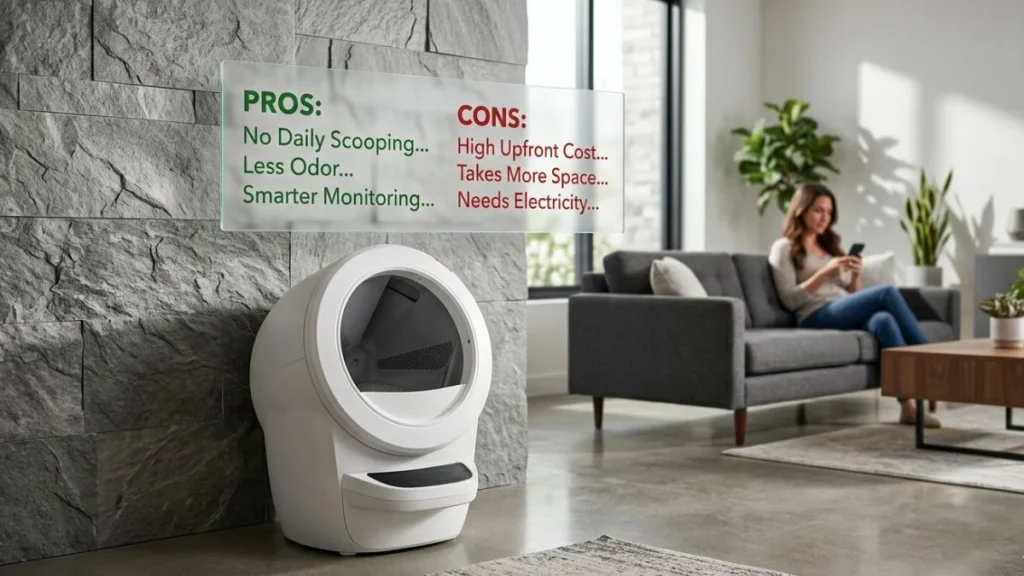
Disadvantages: Upfront Cost, Size, and Learning Curve
Like any premium product, the Litter-Robot 4 comes with a few considerations that are important to understand before buying.
Higher Upfront Cost
The most common concern is the initial price. Compared to a standard litter box, this is a significant upfront investment — which may not fit every budget.
Larger Physical Footprint
This is not a compact unit. At nearly 30 inches tall with a wide base, it requires a dedicated space in your home. Proper placement near an outlet is essential.
Adjustment Period for Cats
Some cats may take time to adapt to a new system. While many adjust quickly, others need a gradual transition and a bit of patience to feel comfortable.
Initial Setup and App Learning Curve
Setting up the Whisker app and connecting via Wi-Fi can take a little time, especially on the first try. However, once configured, the system runs smoothly with minimal intervention.
That said, these drawbacks tend to be short-term or one-time adjustments rather than ongoing frustrations.
When viewed over the long term, the equation often shifts.
Savings on litter, reduced daily effort, and improved hygiene can outweigh the initial cost — especially for households looking for convenience.
As one user summarized it: “The pros heavily outweigh the cons… if it fits your budget, it’s worth it.”
| Advantages (Pros) | Disadvantages (Cons) |
|---|---|
| Time Freedom: Eliminates daily scooping and saves many hours per year | High Upfront Cost: Requires a significant initial investment |
| Smart Convenience: Wi-Fi connectivity for remote monitoring and control | Large Footprint: Needs dedicated space and careful placement |
| Superior Hygiene: Sealed system with carbon filter traps odors effectively | Pet Acclimation: Some cats require a gradual adjustment period |
| Quiet Operation: Gentle cleaning cycle suitable for sensitive pets | Ongoing Supplies: Liners and odor packs may add minor recurring costs |
| Long-Term Savings: Uses litter efficiently, reducing ongoing expenses | Tech Dependency: Requires power and stable Wi-Fi; occasional troubleshooting may be needed |
Final Verdict: Is the Litter-Robot 4 Worth It?
In the end, the Litter-Robot 4 proves to be more than just a smart gadget — it’s a true upgrade to your daily routine as a cat owner.
Instead of dealing with constant cleaning, odor control, and maintenance, you move to a system that works quietly in the background, keeping things clean with minimal effort.
Yes, the upfront cost and size require consideration.
But when you weigh that against the time saved, improved hygiene, and long-term convenience, the value becomes clear.
For many owners, the moment they realize they’ll never have to scoop again is when the decision becomes easy.
If you’re looking for a cleaner home, less daily effort, and a more modern approach to pet care, this is one of the most effective upgrades you can make.
Litter Compatibility: Choosing the Right Clay for the Job
Choosing the right litter isn’t just a detail — it’s essential for the system to work properly.
In a self-cleaning litter box like the Litter-Robot 4, the litter acts as the “fuel” that powers the entire cleaning process. Using the wrong type can lead to clumping issues, sensor errors, and inconsistent performance.
The patented sifting system depends on litter that forms firm, fast clumps.
This is what allows the unit to separate waste from clean litter efficiently, without breaking apart or creating excess residue inside the globe.
In real-world use, the difference is noticeable.
With the right litter, the system runs smoothly and stays clean for longer. With the wrong one, you may experience poor separation, wasted litter, and more frequent maintenance.
That’s why sticking to recommended clumping clay formulas is so important.
It not only improves daily performance but also helps protect your investment over the long term.
In the next section, we’ll break down the best types of litter to use — and what you should avoid to keep everything running smoothly.
Recommended Clumping Litters for Optimal Performance
For the best results, it’s essential to use a high-quality clumping clay litter that forms tight, fast clumps.
The Litter-Robot 4 performs best with fine-grained, low-dust formulas, as they create solid clumps that hold together during the cleaning cycle without breaking apart.
In real-world use, choosing the right litter makes a noticeable difference in both performance and maintenance.
Some of the most trusted and widely used options include:
- Tidy Cats → reliable clumping and easy to find
- Scoop Away → strong odor control and consistent performance
- Arm & Hammer Clump & Seal → excellent sealing and low dust
Another option is GreatLitter (by Whisker), which is specifically designed for automatic litter boxes like the Litter-Robot.
It’s often included in bundle packages and features a low-tracking, low-dust formula that works well with the system’s sifting mechanism.
Many users test a few options before settling on their favorite.
As one owner shared, “After trying a few, I found a specific clay blend that reduced tracking by half.”
A smart approach is to start with a small test batch before fully committing, ensuring the litter performs well with your cat and your setup.
Litters to Avoid with Automatic Self-Cleaning Boxes
Not all cat litters are compatible with automatic systems — and choosing the wrong type can lead to poor performance or even mechanical issues.
To avoid problems, it’s important to stay away from certain materials that don’t work well with the Litter-Robot’s sifting system.
Avoid these types of litter:
- Crystal (silica) litter → does not clump, making separation impossible
- Paper-based litter → too soft and breaks apart easily
- Non-clumping litter → cannot form solid waste clumps
Additional types that often cause issues include:
- Wood pellets → too large and don’t pass through the sifter
- Newspaper-based litter → lacks structure for proper clumping
- Loose or weak clumping formulas → break apart during the cleaning cycle
Using any of these can result in incomplete cleaning, wasted litter, and potential system errors.
There’s also a smaller detail that many users overlook.
Very light-colored or translucent clay litters may interfere with sensor accuracy, particularly when detecting low litter levels. While not a major issue, it’s something to keep in mind for optimal performance.
Here’s a quick list of materials to avoid:
- Non-Clumping / Absorbent Litters:
Crystal, silica gel, or paper-based options that don’t form solid clumps. - Natural Pellet Litters:
Wood, pine, corn, or wheat pellets that are too large for proper sifting. - Poorly Clumping Clay:
Formulas that create loose or crumbly clumps, leading to incomplete cleaning. - Light-Colored Granules:
Very white or translucent clay that may interfere with sensor accuracy.
Testing a new litter doesn’t have to be complicated.
A smart approach is to introduce it gradually by mixing a small amount with your current, compatible litter.
Over the course of a week, monitor how the system performs — paying close attention to clump strength and cleaning cycle efficiency.
This simple step helps you avoid potential issues before fully committing to a new product.
In real-world use, this cautious method ensures your automatic litter box continues to run smoothly and consistently over time.
Choosing the right litter isn’t just about performance — it also plays a key role in extending the lifespan of your unit.
It improves odor control, reduces maintenance, and keeps the system operating as intended.
While the Litter-Robot 4 is flexible, following this one principle makes a big difference:
Use a reliable clumping litter and test before fully switching.
Is the Litter-Robot 4 Right for Multi-Cat Households?
For homes with more than one cat, litter box management becomes significantly more challenging.
More cats mean more waste, more odor, and more frequent maintenance — which is exactly where an automatic system can make the biggest difference.
The Litter-Robot 4 is officially rated to handle up to four cats, making it a strong option for multi-cat households.
However, real-world performance depends on your home’s specific routine.
Factors like how often your cats use the box, their size, and their habits can all influence how well the system keeps up.
In many cases, the unit performs exceptionally well — but higher usage naturally means the waste drawer will fill faster and require more frequent emptying.
The key question isn’t just capacity, but whether the system can maintain consistent cleanliness under heavier daily use.
Capacity and Workflow for Two, Three, or Four Cats
The main limitation in multi-cat households comes down to waste drawer capacity.
With more cats using the unit, the drawer naturally fills faster — which means more frequent emptying is required.
For two cats, most owners find that emptying the drawer twice per week is enough.
With three to four cats, maintenance may increase to every day or every other day, depending on usage.
Despite this, the system maintains a key advantage.
After each use, the cleaning cycle activates automatically, ensuring a consistently clean litter bed for every visit.
This is especially important in multi-cat homes, where cleanliness directly impacts whether cats continue using the same box.
The unit also requires a short delay between uses to allow proper clumping before the cleaning cycle begins.
In real-world use, this delay is rarely an issue — even in busy households — and still allows the system to keep up with demand.
Overall, the Litter-Robot 4 handles multi-cat workflows effectively, as long as expectations around maintenance frequency are realistic.
The Case for Multiple Units in a Large Home
Feline experts often recommend having one litter box per cat, plus one extra.
This guideline helps reduce competition, stress, and behavioral issues — and it applies just as well to automatic litter boxes.
For households with one or two cats, a single Litter-Robot 4 is usually enough to handle daily use comfortably.
However, once you reach three or more cats, adding a second unit becomes a much more practical solution.
This prevents the waste drawer from filling too quickly and ensures that each cat has consistent access to a clean, stress-free space.
In multi-cat environments, this can make a noticeable difference in both hygiene and behavior.
The Whisker app becomes even more valuable in this setup.
With the Litter-Robot Connect feature, you can manage multiple units from a single dashboard — tracking usage, receiving alerts, and monitoring drawer levels across all devices.
In real-world use, owners consistently report a major reduction in daily effort.
As one user put it: “It’s a game-changer — but you do need to stay on top of emptying it.”
While investing in multiple units is a bigger upfront commitment, the return comes in the form of time saved, better odor control, and improved household harmony.
Over time, what used to be a constant chore becomes a simple, manageable routine — even in busy multi-cat homes.
Strategic placement is essential when using multiple units. Follow these tips to get the best results:
- Separate Locations:
Place each unit in different, low-traffic areas to reduce territorial behavior and give each cat a comfortable space. - Proper Setup Conditions:
Make sure every location has a level surface, easy access, and a nearby power outlet for consistent performance. - Consistent Litter Choice:
Use the same clumping clay litter in all units to maintain predictable performance and avoid confusion for your cats. - Monitor Usage and Weight Trends:
Keep an eye on your pets’ habits through the app. While weight tracking is helpful, data may be combined for cats with similar sizes, so interpret trends accordingly.
In the end, the Litter-Robot 4 can be an excellent solution for multi-cat households when used with the right expectations.
The key is understanding how the system scales with usage and adjusting your setup accordingly — whether that means emptying the drawer more frequently or adding a second unit.
In real-world use, households that follow these strategies experience consistent cleanliness, better odor control, and far less daily effort.
Even in busy homes with multiple cats, what used to be a constant chore becomes a simple and manageable routine.
With the right setup, this system delivers a level of convenience that traditional litter boxes simply can’t match.
Litter-Robot 4 vs. Traditional and Other Automatic Boxes
When comparing litter box options, the difference between traditional and automatic systems becomes immediately clear — especially in terms of daily effort, hygiene, and long-term value.
A traditional litter box requires manual scooping every single day, with waste left exposed between cleanings. Over time, this leads to odor buildup and inconsistent hygiene.
Automatic litter boxes, on the other hand, are designed to eliminate manual scooping by separating waste shortly after each use. This reduces odor, limits contact with waste, and keeps the litter consistently clean.
The Litter-Robot 4 takes this a step further.
Its rotating sifting system automatically removes waste into a sealed drawer, helping control odor more effectively than many competing models.
How It Compares to Other Automatic Litter Boxes
Among automatic options, not all systems perform equally.
Many mid-range models offer similar automation but come with trade-offs like:
- smaller waste compartments
- louder cleaning cycles
- less effective odor control
For example, competitors like Petkit PuraMax are more compact and affordable, but may require more frequent maintenance and offer weaker odor containment.
Higher-end alternatives such as Leo’s Loo Too provide similar smart features, but often differ in size, design, and overall efficiency.
In multiple tests and reviews, the Litter-Robot 4 consistently stands out for its:
- quiet operation
- larger capacity
- strong odor control system
- reliability in multi-cat homes
Traditional vs Automatic vs Litter-Robot 4 (Quick Breakdown)
- Traditional litter box → lowest cost, but highest daily effort and odor issues
- Basic automatic models → reduced effort, but may require more maintenance and compromise on performance
- Litter-Robot 4 → premium price, but delivers the most complete balance of automation, hygiene, and convenience
What This Means in Real Life
In everyday use, the difference isn’t just technical — it’s experiential.
Instead of managing a daily chore, you shift to a system that:
- keeps the litter clean automatically
- reduces odors significantly
- minimizes hands-on maintenance
That’s why many users see it not just as a product, but as a long-term upgrade to their lifestyle as pet owners.
Comparing Cost, Effort, and Hygiene Over Time
The price of a premium self-cleaning litter box is often the biggest concern upfront.
However, when you look at the long-term picture, the value becomes much clearer.
Thanks to its efficient sifting system, the Litter-Robot 4 uses significantly less litter over time. In many cases, usage can drop by up to 50% compared to manual scooping, especially when paired with the right material — as explained in our guide on choosing the best cat litter for automatic litter boxes.
This reduction adds up to meaningful savings over months and years, helping offset the initial investment.
Daily effort also changes dramatically.
With a traditional litter box, you’re dealing with manual scooping every single day. In contrast, an automatic system reduces this to a quick weekly routine, which is why many owners switch after seeing how these systems perform in real-world use.
That’s a major reduction in time spent on a repetitive chore.
Hygiene is where the difference becomes even more noticeable.
In a traditional setup, waste remains exposed between cleanings, allowing odors and bacteria to spread throughout your home.
Automatic systems address this by removing waste shortly after each use — helping maintain a consistently cleaner and more controlled environment, especially when combined with proper maintenance and odor control strategies like those covered in common litter box smell fixes.
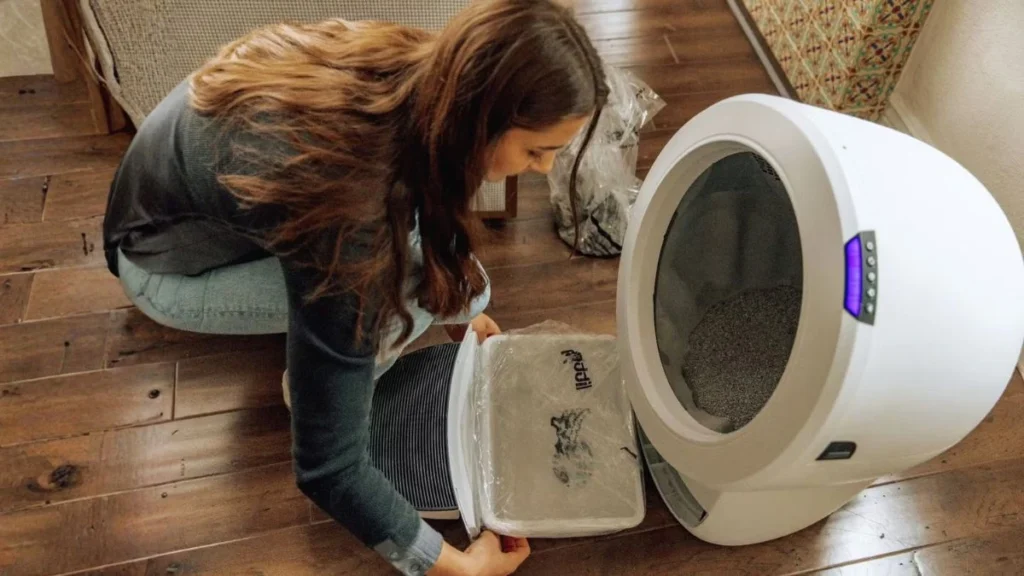
This self-cleaning litter system removes clumps shortly after each use, keeping the litter consistently clean throughout the day.
The sealed waste drawer plays a major role in this process, helping contain odors before they spread and keeping your home noticeably fresher with minimal effort.
This isn’t just a marketing claim — it’s backed by real-world testing.
In an expert evaluation by Good Housekeeping, the product was described as “an impressive piece of engineering that really works,” highlighting its reliability and performance in everyday use.
How It Stacks Up Against Competitor Models
Not all automatic litter boxes operate the same way — and the differences become clear in daily use.
Many entry-level models rely on rake-based cleaning systems, which can be louder and more prone to jamming over time. This often leads to inconsistent performance and more frequent maintenance.
The Litter-Robot 4 takes a different approach.
Instead of a rake, it uses a gentle rotating sift cycle, which is quieter, more reliable, and better at separating waste from clean litter. This design is one of its most important advantages.
Some newer competitors are beginning to introduce advanced features like AI cameras or individual cat recognition.
While these innovations sound impressive, they usually come with a significantly higher price point and don’t always improve the core function of cleaning performance.
The Litter-Robot 4 focuses on what matters most.
It offers a large waste drawer, strong odor control, and reliable day-to-day operation, backed by consistent support from the Whisker brand.
Of course, there are a few trade-offs to consider.
The unit requires more space than compact models, and it cannot reliably distinguish between cats of similar weight. For most households, however, these are minor limitations compared to the overall convenience.
The table below provides a clear, side-by-side comparison of how it performs against other automatic litter boxes.
| Feature | This Self-Cleaning Model (Litter-Robot 4) | Typical Rake-Based Competitor | Advanced Competitor Model |
|---|---|---|---|
| Noise Level | Very quiet (similar to a soft rain sound) | Moderate to loud (mechanical movement) | Generally quiet |
| Litter Compatibility | Works best with standard clumping clay litter | Often limited to specific or proprietary litter | Compatible with clumping clay litter |
| App & Connectivity | Full control via Whisker app with real-time tracking | Basic alerts or no app integration | Advanced app with video and tracking features |
| Durability | Proven reliability over years of real-world use | More prone to mechanical jams and wear | Newer systems with less long-term data |
| Cat Differentiation | No (relies on weight tracking only) | No | Yes (via microchip or camera recognition) |
| Primary Advantage | High reliability and large capacity | Lower upfront cost | Advanced monitoring and smart features |
In the end, the Litter-Robot 4 stands out as a top-tier choice among automatic litter boxes.
Rather than focusing on flashy extras, it delivers where it truly matters — consistent performance, reliability, and ease of use.
It effectively solves the core challenges every cat owner faces: odor control, daily effort, and long-term maintenance.
In real-world use, this translates into a cleaner home, less time spent on chores, and a more comfortable experience for both you and your pet.
For anyone looking for a hands-off, dependable solution, it remains one of the most practical and well-rounded upgrades in modern pet care.
Value Proposition: Is the Litter-Robot 4 Worth the Price?
A product like the Litter-Robot 4 naturally raises one big question: is the price really justified?
At first glance, the upfront cost can feel high compared to a traditional litter box. But the real answer only becomes clear when you look beyond the purchase price and consider the long-term value it delivers.
This isn’t just about buying a more advanced litter box.
It’s about reducing daily effort, improving odor control, using less litter over time, and gaining back hours that would otherwise be spent scooping and cleaning.
For some households, that convenience alone is enough to justify the investment.
For others, the value comes from the combination of time saved, better hygiene, lower ongoing litter waste, and a more consistent experience for both owner and cat.
To decide whether it’s worth the price for your situation, you need to look at the full picture — not just the initial cost, but the ongoing savings, daily convenience, and overall quality-of-life improvement it can provide.
Breaking Down the Cost Over the Product’s Lifespan
At first glance, a price of around $700 can feel like a major investment.
But when you look at it over time, the perspective changes.
With solid construction and strong long-term reviews, the Litter-Robot 4 is designed to last five years or more. Spread over that period, the cost comes down to roughly $140 per year — before factoring in any savings.
One of the biggest advantages comes from litter efficiency.
Thanks to its precise sifting system, many users see a reduction of up to 50% in litter usage. For someone spending about $20 per month, that adds up to around $120 saved per year.
Then there’s something most people overlook: your time.
Eliminating daily scooping can save over 70 hours per year. Even valuing your time conservatively at $10 per hour, that represents $700 worth of time annually.
Hygiene also plays a role in long-term value.
Because waste is removed shortly after each use, the environment stays cleaner, which may help reduce issues related to poor litter box conditions — potentially avoiding extra costs over time.
Now compare that to a traditional litter box.
While the upfront cost is low, the ongoing expenses — including litter, liners, and replacements — quietly add up. Over several years, it’s not uncommon for those costs to exceed $1,000 without delivering the same level of convenience or cleanliness.
| Cost Factor (5-Year Period) | Traditional Litter Box Setup | This Self-Cleaning Unit (Litter-Robot 4) |
|---|---|---|
| Upfront Purchase | $30 – $50 (basic box) | ~$700 |
| Annual Litter Cost | $240 (at $20/month) | ~$120 (up to 50% savings) |
| Time Spent Scooping | 350+ hours over 5 years | 0 hours |
| Odor & Hygiene Control | Poor — waste remains exposed daily | Excellent — sealed waste system |
| Overall Experience | Manual, time-consuming, inconsistent | Automated, consistent, hands-off |
| Estimated 5-Year Total | ~$1,200+ (materials + time cost not included) | ~$1,300 (device + litter) |
When you look at the full picture, the cost difference is not as large as it first seems.
Once you factor in litter savings, reduced daily effort, and the value of your time, the gap narrows significantly.
In many cases, the automated option actually comes out ahead.
What initially feels like a higher upfront cost turns into a more efficient and valuable long-term solution.
And when you add the benefits of better odor control and a consistently cleaner environment, the advantage becomes even clearer.
Warranty and Whisker’s Customer Support Reputation
Protecting your investment is crucial. The Whisker brand offers the WhiskerCare Extended Warranty. This plan provides comprehensive protection for three full years.
It covers accidental damage, power surges, and mechanical breakdowns. Software support and free shipping for repairs are included. This hassle-free coverage adds significant peace of mind.
The company’s customer support team is based in the U.S. Users report responsive and helpful service. This strong reputation is a key part of the overall experience.
“Their support team walked me through a sensor reset in minutes,” one owner shared. This level of service supports the product‘s premium positioning.
Protecting your investment is an important part of the decision — especially at this price point.
Whisker offers an extended protection plan called WhiskerCare, which provides coverage for up to three full years. This includes protection against mechanical issues, accidental damage, and even power-related problems.
It also covers software support and includes free shipping for repairs, making the entire process more convenient and stress-free.
Beyond the warranty itself, customer support is where the brand truly stands out.
Whisker’s support team is U.S.-based, and many users report fast, helpful responses when issues arise. As one owner shared, “Their support team walked me through a sensor reset in minutes.”
This level of service reinforces the product’s premium positioning and adds confidence to the overall experience.
The unit is also backed by years of development and ongoing improvements. Through the litter-robot connect system, firmware updates are delivered automatically, ensuring the product continues to evolve over time.
Who Gets the Most Value from the Litter-Robot 4?
This is where the value becomes very clear.
The Litter-Robot 4 delivers exceptional benefits for those who:
- Want to eliminate daily scooping completely
- Have multiple cats at home
- Travel frequently or stay away for long periods
- Value convenience, hygiene, and automation
For busy professionals, the time savings alone can be significant.
Instead of managing a daily chore, the system handles cleaning automatically — giving you back hours every week.
On the other hand, if you have a tight budget or very limited space, the value may be less compelling. In those cases, a simpler setup might make more sense.
Final Verdict: Is It Worth It?
If you can afford the initial investment and prioritize convenience, cleanliness, and long-term efficiency, the answer is yes.
The Litter-Robot 4 delivers exactly what it promises:
- A consistently clean litter box after every use.
- Strong odor control with minimal effort.
- A fully automated experience that replaces daily maintenance.
Over time, it transforms a repetitive chore into a simple, managed routine.
For the right type of owner, this isn’t just a product — it’s a lifestyle upgrade that pays off in time, comfort, and peace of mind.
The Litter-Robot 4 in 2026: Anticipating Lasting Relevance
As smart home technology continues to evolve, a natural concern arises: will today’s devices still feel relevant in a few years?
When investing in a premium automated litter box, this question becomes even more important.
The Litter-Robot 4 is designed with this exact concern in mind.
Rather than focusing only on immediate convenience, it’s built as a long-term solution that adapts over time.
This comes down to two key factors: durable hardware and ongoing software support.
From a hardware perspective, the unit is engineered with high-quality components designed to withstand daily use over several years.
On the software side, the experience continues to evolve.
Through the litter-robot connect system, the device receives firmware updates that improve performance, refine features, and ensure compatibility with modern smart home environments.
This means the product doesn’t stay static after purchase — it continues to improve.
As smart ecosystems expand, devices that can update and adapt maintain their value far longer than those that cannot.
That’s what positions the Litter-Robot 4 as more than just a current solution — it’s a future-ready investment in your home and your pet’s routine.
Built to Last: Durability and Software Update Support
The long-term value of the Litter-Robot 4 starts with its solid physical construction.
Built with high-quality materials and thoughtful engineering, the unit is designed to handle daily use over many years without compromising performance. This durability is a key part of what makes it a reliable long-term investment.
Another important advantage is its modular design.
Instead of replacing the entire unit if something wears out, owners can swap individual components — such as the globe or waste drawer — extending the product’s lifespan and reducing unnecessary waste.
But what truly sets it apart is what happens beyond the hardware.
The Litter-Robot 4 receives over-the-air firmware updates, meaning the product can improve over time. As new features and optimizations are released, they are delivered directly through the system without any manual intervention.
In practical terms, this means your device doesn’t become outdated — it evolves.
Whisker’s ongoing investment in research and development ensures continuous improvements to both the hardware ecosystem and the app experience. This ongoing support reinforces confidence in the product’s longevity.
When you combine durable construction, replaceable components, and continuous software updates, you get more than just a self-cleaning litter box.
You get a future-ready system designed to remain relevant, efficient, and valuable for years to come.
How Its Design Philosophy Aligns with Future Pet Tech
Pet technology is moving in a clear direction — more connectivity, smarter automation, and deeper health insights.
The Litter-Robot 4 is already aligned with these trends.
Its built-in Wi-Fi capability and the litter-robot connect system create a strong foundation within the modern smart home ecosystem. It’s not just a standalone device — it’s part of a connected environment.
One of its most forward-looking features is weight-based health tracking.
As pet technology evolves, this type of data is expected to integrate with broader wellness platforms, helping owners monitor long-term health trends more effectively.
Looking ahead, smart home integration will only become more seamless.
Because the system is supported by a stable app and ongoing updates, it is well-positioned to remain compatible as new standards and integrations emerge.
Future models may introduce advanced features like individual pet identification or AI-based monitoring.
However, the Litter-Robot 4 already delivers what matters most: reliable automation, strong odor control, and consistent daily performance — without the premium price of experimental features.
Another important aspect is long-term sustainability.
Its durable construction reduces electronic waste over time, while efficient litter usage minimizes environmental impact. This makes it not only a practical choice, but also a more responsible one.
In the end, this is not just a product designed for today.
With its combination of durability, smart connectivity, and continuous software support, the Litter-Robot 4 is built to remain relevant for years to come.
For pet owners looking for a dependable, long-term solution, it represents a smart investment in both convenience and future readiness.
Conclusion: Our Final Verdict on This Feline Tech Marvel
After a complete evaluation, the conclusion is clear: the Litter-Robot 4 delivers on its promise.
It eliminates the daily scooping routine, provides consistent odor control, and uses litter far more efficiently than traditional setups.
Independent testing and expert feedback reinforce this. As one review noted, it’s “an impressive piece of engineering that really works,” highlighting its reliability in real-world use.
Of course, the upfront cost and larger size are important considerations.
But for those who can make the investment, the long-term return is significant — not just financially, but in time saved, convenience, and overall quality of life.
This unit is especially well-suited for:
- Households with one to four cats
- Busy owners who want a hands-off solution
- Anyone prioritizing hygiene and automation
The strong Whisker warranty and responsive customer support further reduce the risk, making this a confident purchase.
In the end, this isn’t just a litter box upgrade.
It’s a shift from a daily chore to an automated system that works quietly in the background.
If you’re looking for a reliable, hygienic, and time-saving solution, the Litter-Robot 4 stands out as one of the best choices available in modern pet care.
FAQ: Litter-Robot 4 (2026)
What type of cat litter works best with the Litter-Robot 4?
For reliable performance, use premium, unscented clumping clay litter. The system is designed for litter that forms solid clumps, allowing efficient separation. Lightweight, crystal, or non-clumping options can cause issues and should be avoided.
See recommended options:
https://cattechadvisor.com/best-cat-litter-for-automatic-litter-boxes-2026-low-dust-odor-control/
Is the Litter-Robot 4 suitable for a home with multiple cats?
Yes. It’s designed to handle up to four cats, thanks to its large waste drawer and efficient cleaning cycle. For larger households, using two units in separate areas can improve hygiene and reduce territorial stress.
Full guide here:
https://cattechadvisor.com/best-automatic-litter-box-for-multiple-cats-2026-top-picks-that-actually-handle-heavy-use/
How do I get my cat to start using the Litter-Robot 4?
Patience is key. Start by keeping the unit turned off and placing it next to your current litter box. Let your cat explore it naturally. Once they begin using it consistently, you can turn it on. Gradual transition works best.
How often do you need to empty the waste drawer?
For one cat, typically every 5 to 10 days. For multiple cats, it may need to be emptied more frequently. The app provides alerts when the drawer is full, making maintenance easier.
Does the Litter-Robot 4 help monitor my cat’s health?
Yes — but indirectly. The system tracks weight and usage patterns, which can help identify changes in behavior. However, it is not a medical device and does not provide diagnoses.
Is the Litter-Robot 4 worth the investment?
For many owners, yes. When you consider time saved, improved hygiene, and reduced litter usage, the long-term value becomes clear. It’s especially beneficial for busy households.
What maintenance is required for long-term use?
Maintenance is minimal. A quick weekly wipe-down, occasional deep cleaning, and replacing the waste liner when full are usually enough to keep the system running smoothly.
How does the Litter-Robot 4 control odors so effectively?
It uses a sealed waste drawer system with carbon filters. Waste is contained immediately after each use, preventing odors from spreading and keeping your home fresher.
Is the Litter-Robot 4 safe for cats?
Yes. It includes multiple safety features such as motion sensors, weight detection, and automatic cycle interruption to ensure safe operation.
Learn more about safety:
https://cattechadvisor.com/are-automatic-litter-boxes-safe-for-cats/